Making Zambia's Growth Poles More Inclusive

Zambia continues to face increasing climate variability and shocks especially droughts, floods, and cyclones. These undermine agricultural and energy production, with subsequent negative impacts on food and water security, incomes, and livelihoods. Zambia’s national development strategies prioritise geographically targeted investments or ‘growth poles’ in agriculture, mining, tourism, and manufacturing, which are intended to serve as engines of pro-poor growth.

This policy brief synthesises evidence on whether growth poles – particularly mining areas, sugar estates, farm blocks including agro-processing yards, tourism areas, and industrial yards – contribute to poverty reduction and climate resilience in Zambia, and proposes policy measures that are needed to strengthen the poverty reduction and resilience-building effects of growth poles. It draws on nationally representative panel data – the 2012, 2015, and 2019 Rural Agricultural Livelihoods Survey (RALS), and the 2022 Living Conditions Monitoring Survey (LCMS) – complemented by spatial analysis and extensive qualitative fieldwork.

Authors: Andrew Shepherd, Mary Lubungu, Cleopas Sambo, Benny Kabwela, Richard Bwalya, Arthur Moonga, Vidya Diwakar and Herrick Mwewa

Transforming Climate and Socioeconomic Resilience among Poor and Vulnerable Rural and Urban Households in Zambia

Front cover of policy brief

Zambia faces a dual challenge of persistent poverty and escalating climate risks, particularly droughts and floods, which increasingly disrupt livelihoods, infrastructure, and macroeconomic stability. This policy brief synthesises findings from a comprehensive policy and programme analysis examining how national frameworks address climate adaptation, disaster risk management, and social protection. The analysis indicates that Zambia has developed a robust policy architecture anchored in Vision 2030, the Eighth National Development Plan, and the National Adaptation Plan. However, systemic gapsremain in financing, coordination, data integration, and implementation effectiveness.

Resilience (defined here as the capacity of households to recover from shocks) is typically achieved by households at high levels of welfare. The key question is how policies and public action can help households at lower levels of welfare to achieve higher degrees of resilience.

While notable progress has been achieved through institutional reforms, early warning systems, climate-smart agriculture initiatives, and digital social registries, resilience investments are fragmented and predominantly donor driven. The transition from reactive crisis response towards anticipatory, risk-informed governance is underway but incomplete. Rural populations remain highly exposed due to reliance on rain-fed agriculture and natural resources, while urban vulnerabilities are rising, with rapid informal settlement growth and infrastructure deficits.

This brief proposes consolidating existing frameworks into a national resilience strategy, supported by predictable financing, integrated data systems, greater capacity at local level, and strengthened accountability mechanisms. Embedding resilience within fiscal policy, incentivising private sector engagement, and enhancing subnational and, especially, community-level (first responder) implementation capacity are central to achieving sustainable outcomes.

Authors: Bridget Bwalya, Richard Bwalya, Vidya Diwakar, Felix Kalaba, Lukonga Luwabelwa, Arthur Moonga, Kate Pruce, Andrew Shepherd, and Marja Hinfelaar. Reviewed by Herrick Mwewa, Ministry of Green Economy, Republic of Zambia.

Growth from Below: Poverty Reduction beyond Social Protection in Nigeria

BASIC Research Policy Briefing 11 - Published on 13 October 2025

Agriculture and informal economies provide essential livelihoods in Nigeria, but they face challenges such as climate shocks, conflict, low investment, and financial exclusion. Resilience strategies include diversification, microfinance access and entrepreneurial ventures, but policy support is limited, particularly for informal activities. Government focus needs to shift from taxation to productive support, to enhance financial inclusion, strengthen social protection, and empower women through asset ownership and business development. Sustainable poverty reduction requires adaptive policies that integrate economic stability, peacebuilding, infrastructure, and social resilience.


Cite this publication

Abdulrasaq, K. and Shepherd, A. (2025) 'Growth from Below: Poverty Reduction beyond Social Protection in Nigeria', BASIC Research Policy Briefing 11, Brighton: Institute of Development Studies, DOI: 10.19088/BASIC.2025.027

Social Assistance and Poverty Reduction Amidst Multiple Crises

BASIC Research Policy Briefing 9 - Published on 11 September 2025

BASIC Research in Borno, Nigeria, demonstrates that the provision of social assistance can help build the capacity to escape poverty, even in crises. Studies show that social assistance improves poor people’s consumption levels, human capital formation and economic growth from below. Nigeria has the foundational pieces of social assistance in place (draft policy, programme, social registry) and could expand social assistance coverage rapidly to poor and vulnerable populations affected by polycrises. However, there is a lack of trust in social assistance and in government. Commitment to carrying out regular impact evaluations would improve this evidence base.


Cite this publication

Shepherd, A. et al. (2025) 'Social Assistance and Poverty Reduction Amidst Multiple Crises', BASIC Research Policy Briefing 9, Brighton: Institute of Development Studies, DOI: 10.19088/BASIC.2025.017


Let's go double dipping! Supporting Growth from Below through Cash+

In Zambia, economic growth is primarily driven by large-scale, formal investments in sectors such as minerals, tourism, and services. However, these sectors employ relatively few people and have a limited impact on overall poverty reduction due to weak economic multipliers.

Consequently, Zambia needs complementary efforts focused on “Growth from Below”, small- scale, informal investments at the household level to effectively reduce poverty, particularly in an economy characterised by high inequality and a heavy reliance on minerals. According to the World Bank (2025), Zambia’s economic growth has a minimal effect on poverty alleviation, meaning that even substantial economic growth results in only modest reductions in poverty levels. While governments typically prioritise large-scale investments, a balanced approach that promotes both Growth from Above (GfA) and Growth from Below (GfB) is essential for inclusive and sustainable poverty reduction.

Furthermore, although the minerals sector is economically significant, it inadequately contributes to government revenues due to externalization of financial flows and opaque financial practices on which significant Zambian institutional capacity has been built (Inter-governmental Forum, 2025). Mineral companies are sometimes able to negotiate special agreements with the Ministry of Finance and Planning to minimise or evade taxes and royalties, as in the recent dropping of a 15% export tax. Addressing these transparency and taxation issues, which have long been a concern for the Zambia Revenue Authority (ZRA), is crucial to ensure that revenues from mineral wealth are effectively directed towards supporting broader economic initiatives that can genuinely benefit all Zambians.

Written by Andrew Shepherd

Read the full policy brief here

Evidence From Cash Plus Programmes: Lessons for Zambia

Social protection strategies, and cash transfer programmes in particular, have been on the rise globally since the early 2000s. By 2019, 35 African countries had adopted a national social protection policy or strategy. Cash plus approaches (including graduation programmes) addressing a wider range of socioeconomic outcomes emerged more recently and have expanded quickly. The Zambian government approved a cash plus approach in 2022, and a range of cash plus interventions are already being implemented. Exploring cash plus experiences and evidence from other countries is key to informing programme development, with a focus on what we can learn from these contexts that is relevant for Zambia. This includes ‘what works’ in terms of different combinations of cash plus components as well as how to deliver through national and local governance structures.

Authored by Roz Price, Kate Pruce and Rachel Sabates-Wheeler

Click here to read the full report

Let's go double dipping! Supporting Growth from Below through Cash+

In Zambia, economic growth is primarily driven by large-scale, formal investments in sectors such as minerals, tourism, and services. However, these sectors employ relatively few people and have a limited impact on overall poverty reduction due to weak economic multipliers.

Consequently, Zambia needs complementary efforts focused on “Growth from Below”, small- scale, informal investments at the household level to effectively reduce poverty, particularly in an economy characterised by high inequality and a heavy reliance on minerals. According to the World Bank (2025), Zambia’s economic growth has a minimal effect on poverty alleviation, meaning that even substantial economic growth results in only modest reductions in poverty levels. While governments typically prioritise large-scale investments, a balanced approach that promotes both Growth from Above (GfA) and Growth from Below (GfB) is essential for inclusive and sustainable poverty reduction.

Furthermore, although the minerals sector is economically significant, it inadequately contributes to government revenues due to externalization of financial flows and opaque financial practices on which significant Zambian institutional capacity has been built (Inter-governmental Forum, 2025). Mineral companies are sometimes able to negotiate special agreements with the Ministry of Finance and Planning to minimise or evade taxes and royalties, as in the recent dropping of a 15% export tax. Addressing these transparency and taxation issues, which have long been a concern for the Zambia Revenue Authority (ZRA), is crucial to ensure that revenues from mineral wealth are effectively directed towards supporting broader economic initiatives that can genuinely benefit all Zambians.

Authored by Andrew Shepherd

Click here to read the full policy brief

Zambia Poverty Dynamics Research

Front page of policy brief

The policy agenda proposed here builds on good measures already taken by the Government of Zambia in education, social protection, debt relief and macroeconomic management, and addresses the challenges that remain in creating a more prosperous and equal Zambia.

The rate of poverty reduction slowed in Zambia during the 2010s, and especially with the 2019 drought and policy responses to the pandemic. A high level of rural chronic poverty is associated with farming and other natural resource-based occupations, suggesting that natural resource management requires significant policy attention. Surprisingly, chronic poverty is highest in eastern and southern Zambia, despite the maize- and livestock-based economics in those regions.

In the context of continuing climate change, risks to natural resource-based occupations are increasing rapidly, which keeps people poor. Sustained escapes from poverty have not exceeded downward mobility into poverty. Urbanised provinces have typically done better than rural ones in reducing extreme poverty and deprivation. 

Zambia’s debt servicing obligations and low economic growth have meant that public expenditure is constrained, though a little less in 2023 than in 2022 when reduced debt servicing allowed increased allocations to education and social protection budgets among others. Significantly greater public expenditure will be needed to recapture a higher rate of poverty reduction. However, it is also important that expenditure goes to items that will reach and benefit poor and vulnerable people. 

This policy brief recommends a series measures, several of which are already underway, and within a sound macroeconomic management framework that has been put in place.

Download the policy brief

Impacts of the Government of Zambia’s Response to the COVID-19 Pandemic on Poverty

COVID-19 tested the social welfare system that successive governments have been building in Zambia over the last two decades. Zambia had one of the highest poverty rates in the world going into the COVID-19 pandemic as well as overlapping vulnerabilities related to climate change, macroeconomic instability, and high external debt. These and other challenges exposed many people living above the poverty line to impoverishment and pushed households living in poverty further towards destitution.

Civil Society for Poverty Reduction (CSPR), the Chronic Poverty Advisory Network (CPAN), and the Institute of Social and Economic Research (INESOR) have been monitoring the impacts of the pandemic on people living in or near poverty in Zambia since early 2021 in three districts – Lusaka, Kabwe and Chipata - about the reach and impact of these policies. This policy brief reviews the Government of Zambia’s key policies to mitigate the impacts of the COVID-19 pandemic on people living in or near poverty and summarises insights from people affected by these policies about what they have achieved and how they can be improved.

Download the policy brief

The Role of Local Resources in Mitigating the Impact of Covid-19

Governments often found it challenging to mitigate the negative socioeconomic impacts of Covid-19 for households in and near poverty. Local efforts were critical to supplement government measures and implement government guidelines.

In Ethiopia, these efforts mobilised a pre-existing, government supported village network system. In Bangladesh, a network of formal and informal strategies played an important role in increasing assistance to people affected by the pandemic, including through industry-based corporate social responsibility (CSR) initiatives.

This policy brief outlines local responses to and lessons learnt from mitigating the negative socioeconomic impacts of Covid-19.

Download the policy brief

Delegating Authority in Bangladesh to Manage the Covid-19 Pandemic

Bangladesh, like most countries, grappled with the harsh conditions of Covid-19, with little infrastructure and set up of institutions to deal with the consequences of the pandemic.

A country with a large informal economy, and an even larger export manufacturing sector it is highly dependent on, the Bangladesh government had tough decisions to make when it came to saving and protecting the lives of millions, as well as ensuring continued economic activity to save livelihoods.

To strike a balance between protecting both these important factors, the central government adopted a unique approach of mobilising and enabling the local government to implement a lot of measures. Their approach was area centric, in that the local government recognised the needs of their districts, and that looked different for different areas of the country, whether rural or urban, agricultural or industrial focused.

This policy brief outlines some of the local measures and responses that worked in minimising the impact of Covid-19 on the dense Bangladeshi population.

Download the policy brief

Mitigating Learning Disruption During Covid-19: Evidence from India

Long school closures in India during the pandemic caused significant learning disruption, with particularly adverse consequences for marginalised girls and boys.

Data from large-scale representative surveys does not show a massive fall in enrolment because of the closures. However, low levels of basic reading and maths skills among school-age children are concerning. In response, various centrally managed interventions took place during the pandemic (e.g. to encourage enrolment, including through social protection).

Schools also undertook measures with a more direct bearing on children’s learning. Continued efforts are needed to reach severely disadvantaged children who are not enrolled.

Download the policy brief

Migrants’ Vulnerabilities in India During the Pandemic

Migration promotes agglomeration of economic activity in more productive locations and improves employment opportunities for households in less developed regions, alleviating poverty and boosting shared prosperity through remittances.

Most internal migrants’ livelihoods are characterised by circular mobility, mandatory physical presence at work, temporary or seasonal nature of work, and informality. Beside their temporary residential status and lack of access to government welfare schemes, most migrants are vulnerable workers.

The Covid-19 pandemic made them more vulnerable due to its mobility restrictions and total shutdown of the economy during lockdown. The extent of precarity migrants faced depended on existing policies, and how agile policymakers were in responding to the crisis and introducing new policies to protect vulnerable migrants.

Download the policy brief

Lessons on South Africa’s Social Protection Response to Covid-19

South Africa stands out for its social protection response to Covid-19, especially regarding the expansion of programmes, number of beneficiaries and benefit amount.

At the height of the pandemic, the government introduced the emergency Social Relief of Distress (SRD) grant was introduced for over 10 million unemployed adults and informal workers through a digitised system.

Despite successes in expanding the grant system, digitisation of the system presented challenges and led to exclusion errors. An alternative to the country’s school feeding scheme, the National School Nutrition Programme which regularly fed around 10 million children, could not be found.

Download the policy brief

Responding to Polycrisis in Ethiopia and Kenya

The spread of Covid-19 was layered on to various intersecting crises (‘polycrisis’), worsening people’s lives and weakening governments’ responses to the pandemic. Many responses to multiple crises focus on single hazards.

This brief highlights effective responses to Covid-19, drought and conflict from Kenya and Ethiopia, which may offer lessons for future policy and programming that equitably address multiple crises.

It focuses on two examples of how governments and local actors have sought to strengthen people’s ability to cope with multiple crises: through collaboration at different levels of governance across sectors; and strengthening resilience through water management.

Download the policy brief

Measures to Mitigate Pandemic Restrictions

Policy responses to the Covid-19 pandemic in the global South were dominated by movement restrictions and lockdowns imposed in the global North, and not always relevant to the countries or geographical areas where they were imposed.

Countries must be free to decide how to manage a global crisis, so their governments can take decisions that are in the best interests of their citizens, with specific reference to the poorest people, whose lives are already challenging. Many countries’ political and public finance systems could not support mitigating measures to compensate the effects of the lockdowns and restrictions.

Such measures rarely made up for the job losses, income reduction and erosion of social capital caused by closing economies. They also rarely reached some of the groups most affected – including those in the urban informal economy, poor migrants and poor women.

Download the policy brief


The Pandemic, Informality and Poverty: Rethinking Economic Policy Responses to the Informal Economy

Informal workers, who represent over 60 per cent of all workers globally, were disproportionately impacted by the pandemic restrictions and recession.

The pandemic exposed the pre-existing disadvantages that informal workers face as well as the essential goods and services they provide.

To reduce poverty and inequality going forward, it is important to build on this new-found recognition of the contributions of informal workers and promote an enabling policy and regulatory environment towards them.

Download the policy brief

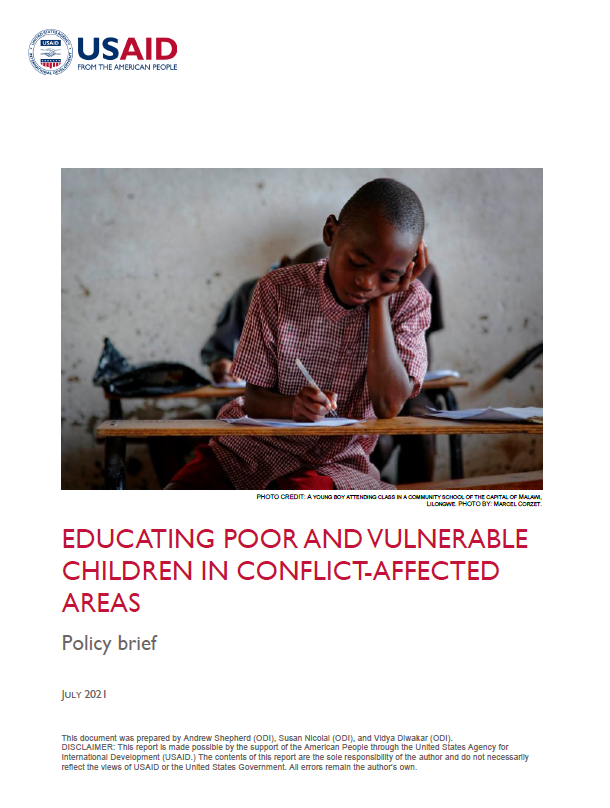
Educating poor and vulnerable children in conflict-affected areas: Policy Brief

Education is recognized to be a ‘portable asset’ (Bird et al. 2010)—one with intrinsic as well as instrumental value and with the potential to contribute to sustained escapes from poverty (Diwakar et al. 2021). However, education access might be compromised in areas affected by armed conflict due to various supply- and demand-side factors. These range from limited state budgets, destruction of infrastructure, displacement of students and teachers, constrained household expenditures, and a general context of insecurity that may limit decisions to enroll. In this way, conflict “damages education from above [through national budgets] and below [through household budgets]” (UNESCO 2011).

Accordingly, a context-specific selection of demand-supporting as well as supply-enhancing measures for promoting formal education is needed in conflict-affected areas (CAAs). Supporting demand for education is critical in CAAs, as conflict can so easily reinforce other constraints on demand. Key demand-boosting measures more generally include: early childhood care and education; school feeding; enhancing quality throughout the system (especially in the early years of primary school); special attention to ensure the continued education of girls; and support for vulnerable children in their transitions between education levels and into the labor market, self-employment or further training. Though not specific to CAAs, a focus on these measures could help ease the financial constraints of households in CAAs, so that the motivation to support children through education remains strong for parents and wider social networks.

There are also supply-side fundamentals which need to be assured in CAAs: above all, that schools need to be safe and secure. Other supply-side needs in CAAs include: improving infrastructure and resources (including teaching materials and updated curricula) to maintain education systems amid widespread insecurity and the destruction (UNESCO 2011); teacher training for work in CAAs; and addressing distributional effects stemming from factors such as restrictions in population movements or the co-option of education by conflict parties (Justino 2016). This is often a big issue in CAA where schools, especially at secondary level, can be arenas of conflict for warring parties.

This brief recommends education policy and programming priorities stemming from recent research on education, conflict, and resilience in sub-Saharan Africa (see Box 1). Based on the research findings, it draws attention to how to meet challenges related to opportunity costs (by investigating how to support poor and vulnerable children into secondary education, and how to improve quality), and how to help link education with labor markets to strengthen households’ financial resilience in CAAs.

Authors: Andrew Shepherd (ODI), Susan Nicolai (ODI), and Vidya Diwakar (ODI).

The full brief can be downloaded here

The associated report can be downloaded here

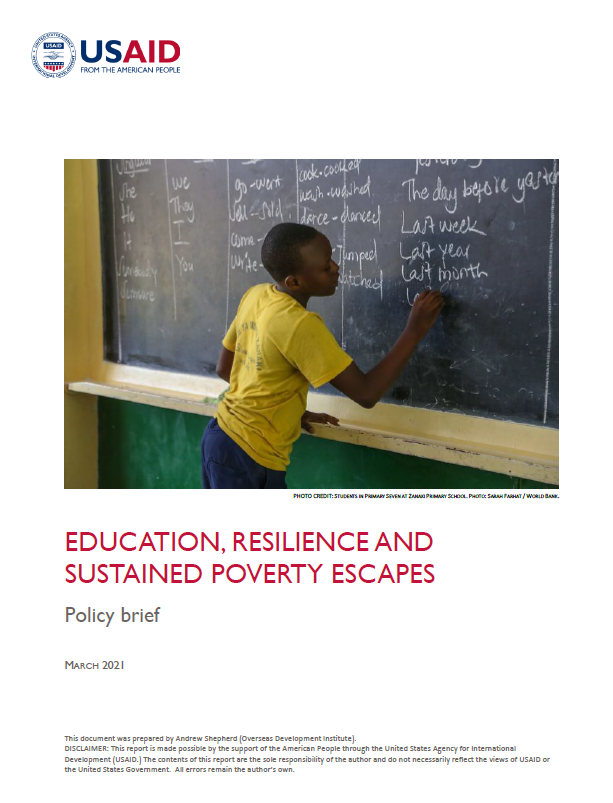
Education, resilience and sustained poverty escapes: Policy Brief

Education is widely recognized as providing pathways out of poverty and a key resource with which to interrupt the inter-generational persistence of poverty.  However, access, progression and quality constraints combined with household disadvantages and sluggish labor markets mean that the potential is not always achieved.  This brief summarizes what can be done to promote a stronger role for education in poverty reduction, based on research which synthesizes findings on education and poverty dynamics across a number of developing countries (see summary in Box 1).  The brief is intended for decision-makers and practitioners in education together with others focused on broader aspects of poverty reduction.

USAID’s approach to education and poverty reduction has been to support ‘learning out of poverty’ and especially the basic education which will help achieve equitable access and sustained improved learning outcomes (USAID Education Policy 2018).  Better learning outcomes for poor children lead to higher future child survival rates, lifelong higher productivity and incomes, protection against ill health, and, in the case of educated women, a higher rate of investment in family by comparison with that of men.  Building human capital contributes to achieving the inclusive and sustainable economic growth which in turn reduces extreme poverty.  This brief not only reflects on education policy and programming priorities emerging from research on poverty dynamics and education, but also on how to promote the kind of household resilience capacities which are necessary to support poor children to progress far enough through the education system to make a difference to their and their families’ futures.  There has been less consideration of this latter topic in existing USAID policy documents.


Author: Andrew Shepherd

The brief can be downloaded here

The associated report can be downloaded here


Publication Manual "Good practices and strategies to reduce poverty in conflict-affected contexts in sub-Saharan Africa"

This handbook outlines effective strategies to better consider the interplay between poverty and fragility, conflict and violence in programmes and policies in sub-Saharan Africa (SSA), where most of people living in extreme poverty reside today, many in conflict-affected contexts.

Read More