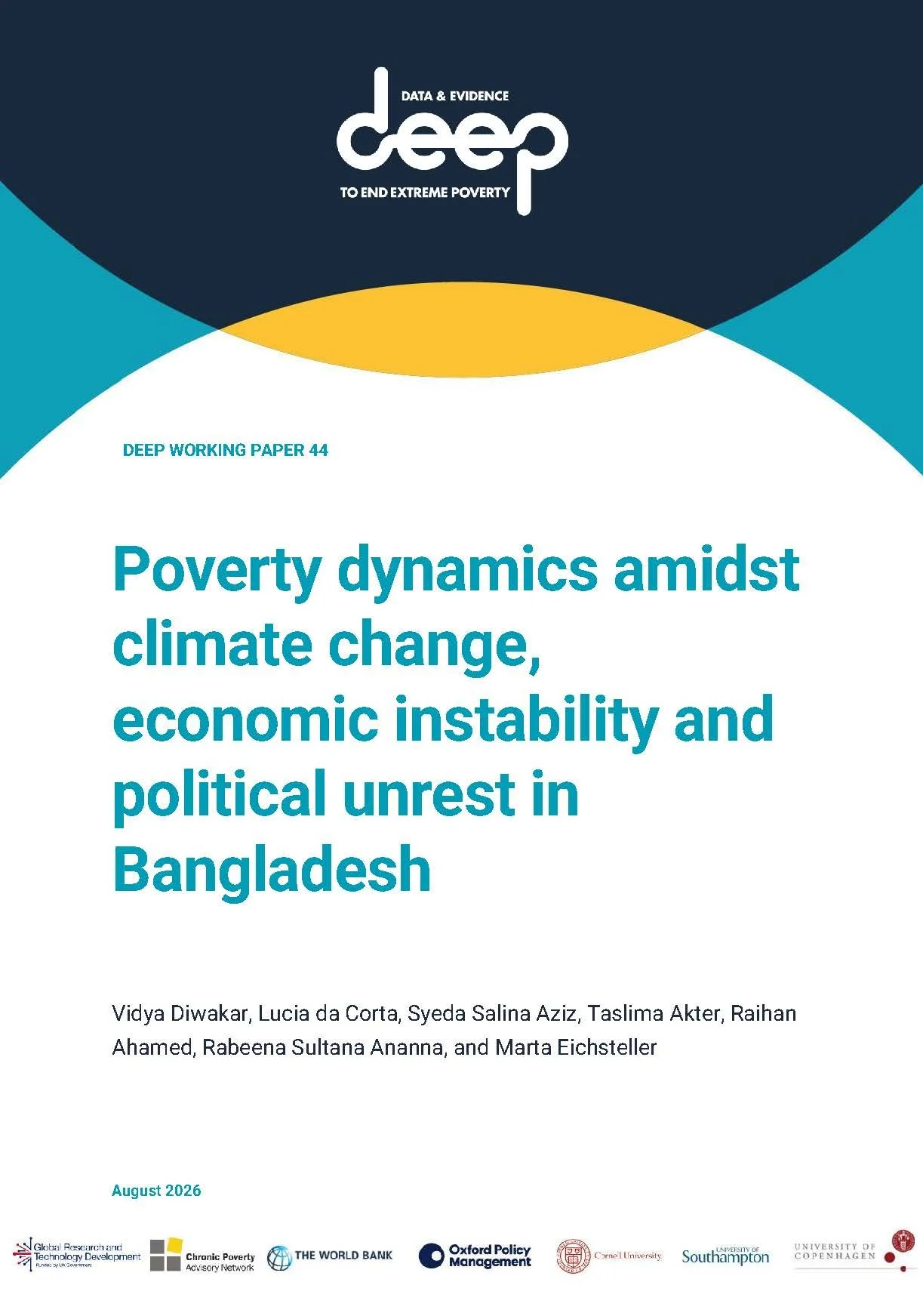
Poverty Dynamics Amidst Climate Change, Economic Instability and Political Unrest in Bangladesh

This paper traces how intersecting crises compound and shape poverty dynamics in Bangladesh. This includes consideration of how these crises keep people in poverty over extended periods of time (chronic poverty) and place those who have escaped poverty at risk of renewed impoverishment (transitory escapes), as well as how some poverty escapes are sustained in a time of intersecting, systemic, and compounding crises and rapid change. What can we learn from those who cope successfully with such crises and are able to move out of poverty and sustain their escape?

This mixed-methods study integrates quantitative analysis of the Bangladesh Integrated Household Survey (BIHS) (2011–2019) (merged at the union level with georeferenced data on floods, droughts, and political violence) with qualitative data newly collected in late 2024. The qualitative component draws on life history interviews, gender-disaggregated and long term resident focus group discussions, and key informant interviews with informants selected through purposive sampling in rural and urban areas of the country to capture variation in exposure to crises and poverty trajectories.

Authors: Vidya Diwakar, Lucia da Corta, Syeda Salina Aziz, Taslima Akter, Raihan Ahamed, Rabeena Sultana Ananna, Marta Eichsteller

Women’s Agency Amid Shocks: A Gendered Analysis of Poverty Dynamics and the Implications for Social Protection in Bangladesh, Peru and the United Republic of Tanzania

The world has experienced multiple crises in recent years– the COVID-19 pandemic, food, fuel and financial crises, climate-related disasters and violent conflict. The need for universal, gender-responsive social protection systems is urgent in this context. This paper employs quantitative panel data and qualitative interviews to present an analysis of gender, poverty dynamics and social protection in three countries spanning different geographies– rural Bangladesh, Peru and the United Republic of Tanzania – amidst shocks and crises. It also examines the implications of these results for social protection system design and implementation.

Results highlight high rates of transient poverty in all three countries, reflecting underlying vulnerability of households and crises-driven downward income mobility. In the face of shocks, women’s resources (e.g., education levels and ownership of phones or financial accounts) and agency within and outside of the household (e.g., right to sell land, comfort in speaking up on public needs) are a critical means of support household resilience. However, adverse financial inclusion and other barriers constrain these efforts. Moreover, low social protection coverage has limited the ability of households and women within them to draw on social protection entitlements to maintain resilience during shocks. Though there was a surge in social protection responses during COVID-19, results suggest that this remained largely inadequate in guarding women’s resilience during the pandemic. Based on the study findings, we derive implications for policymakers and practitioners regarding the gender-responsive design and implementation of social protection during shocks, stressors and crises.

Author: Vidya Diwakar, Deputy Director, Chronic Poverty Advisory Network; Research Fellow, IDS

Read the full paper here

Read the related UN Women blog ‘Gender and poverty amid crisis: What matters for resilience?’ here

Delegating Authority in Bangladesh to Manage the Covid-19 Pandemic

Bangladesh, like most countries, grappled with the harsh conditions of Covid-19, with little infrastructure and set up of institutions to deal with the consequences of the pandemic.

A country with a large informal economy, and an even larger export manufacturing sector it is highly dependent on, the Bangladesh government had tough decisions to make when it came to saving and protecting the lives of millions, as well as ensuring continued economic activity to save livelihoods.

To strike a balance between protecting both these important factors, the central government adopted a unique approach of mobilising and enabling the local government to implement a lot of measures. Their approach was area centric, in that the local government recognised the needs of their districts, and that looked different for different areas of the country, whether rural or urban, agricultural or industrial focused.

This policy brief outlines some of the local measures and responses that worked in minimising the impact of Covid-19 on the dense Bangladeshi population.

Download the policy brief

Disability, poverty and poverty dynamics: a preliminary analysis of panel data, policies and politics in Bangladesh- A Synthesis

This report is a synthesis of the research developed in the framework of the project 'Disability, poverty and poverty dynamics: a preliminary analysis of panel data, policies and politics in Bangladesh' and aims to summarises its main finding and policy implications. 

Read More

Unpacking Disability-Extreme Poverty Links in Bangladesh through Household Income and Expenditure Survey: A Quantitative Exercise

Persons with disability are often considered as a specific chronic poverty group. However, little empirical evidence exists for developing countries on the size of disabled population. Even less is known about the interface between disability and poverty. The present study aims to provide statistically robust analysis of the state of disability and its interface with poverty and vulnerability through different pathways. 

Authors: Binayak Sen, Mainul Hoque 

Read More

(In)tangible assets: The road to economically empowering poor women in Bangladesh and Nigeria

This report assesses drivers of the economic empowerment of chronically poor women and girls in rural Bangladesh and rural Nigeria. The focus is on drivers related to assets, both intangibly in terms of education, and tangibly in terms of ownership of consumption and productive assets including land.

Read More

Poverty dynamics and disability in rural Bangladesh: learning from life-history interviews

This paper explores the relationship between disability and poverty dynamics in rural Bangladesh drawing from 293 life-history interviews conducted by the author and a small team of researchers in 2007. The aim of the paper is to use existing life-history interviews to provide initial insights into the relationship between poverty and disability in Bangladesh.

Author: Peter Davis 

Read More

Ensuring Escapes from Poverty are Sustained in rural Bangladesh

Bangladesh has experienced substantial reductions in both extreme poverty and poverty. The proportion of the population living below the national extreme poverty line has reduced from 50 percent in 1991 to 18 percent in 2010. However, some households escape poverty only to live at a level just above the poverty line. They therefore remain vulnerable to slipping into poverty in the event of a shock or stressor, such as an episode of ill-health or a flood. The specific focus of this report is on “transitory poverty escapes”: a term referring to households that successfully escape from poverty only to return to living in it once again i.e. they become re-impoverished.

Authors: Lucy Scott and Vidya Diwakar

Read More

Exploring the Links Between Poverty and Disability in Rural Bangladesh

This paper explores the links between poverty and disability drawing from 60 qualitative life-history interviews conducted in rural Bangladesh, in 48 households, in three districts, in March 2016. The paper provides insights into the relationship between poverty and disability with the aim of informing policy and practice concerned with both reducing poverty and improving the life chances of people with disabilities.

Author: Peter Davis

Read More

A tale of triple disadvantages: Disability and poverty dynamics amongst women in rural Bangladesh

The focus of the paper is on persistently poor women with disabilities in Bangladesh. It seeks to contribute to the disability and chronic poverty policy discourse and work towards developing effective poverty reduction measures by investigating daily activities and coping strategies of poor persons with disabilities.

Author: Vidya Diwakar

Read More

The State of the Poorest in Bangladesh: tales of ascent, descent, marginality and persistence

Bangladesh has come out of the "shadow of famine", the problem of starvation still persists. Accurate figures are not available for urban areas, but in effect between 25 to 30 million of the country's citizens are chronically poor. Here we review the present status and situation of the poorest, analyse the main factors that keep them in poverty and identify the types of policy that can help them escape deprivation and gain their full rights as citizens of an increasingly prosperous and high-stepping country.

Read More