
Photo credit: Woman in rural Niger; Aoife McCullough, ODI.
Social inclusion is commonly defined as “the process of improving the terms on which individuals and groups take part in society”. But how does that process manifest, and what types of policies and programs might support these processes?
A new CPAN challenge paper argues that a focus on social inclusion alone, without a concurrent emphasis on economic inclusion, will have limited effects for sustained poverty reduction. The paper argues that gendered economic inclusion is necessary to open pathways to social inclusion.
To explore this link between economic and social inclusion, the challenge paper adopts a mixed-methods analysis of social inclusion of poor women and children in Niger and Malawi. Social inclusion outcomes are focused primarily on access to education and health, and supported by gendered processes of inclusion in economic and financial activities.
From economic to social inclusion in Niger and Malawi
The quantitative panel data analysis and life histories examined in Niger and Malawi, the latter undertaken as part of a wider set of CPAN country studies on sustained escapes from poverty, confirm the centrality of the economic inclusion of women in promoting social inclusion for children. For example, social transfers and savings groups in both countries, and reciprocal gift exchanges in Niger, were found to provide women with funds for investments that contributed to their financial and economic inclusion.
Rabi (Life History Interview- LHI, Niger) noted that “Biki is a kind of savings because if you gave money or a present to a woman, [later on] when you give birth, she will give you two times what you gave her the first time… With that money, we are buying livestock.” These funds are often used for investments in human capital of children. Haowa (LHI, Niger) for example sold all five goats she had in 2017 to pay for her son’s surgery.
Mary (LHI, Malawi), received social cash transfers that helped her take care of the school needs of her two grandchildren. She noted, however, that “this money is not enough… The kids have to be well dressed for school. We need soap and lotion on a daily basis for the kids to be presentable at school.” Given insufficient social transfers, it is the quality relationships with relatives and wider social networks that provide resources to enable socially inclusive outcomes for children.
Policy directions to support interactive processes of economic and social inclusion
As economic inclusion of women is critical for social inclusion of children, a key policy implication is around promoting the economic empowerment of women and supporting collaborative intra-household relationships. Part of this involves bringing men into gendered financial inclusion interventions to mitigate adverse effects of women’s increased negotiating power.
Policies that foster beneficial financial and economic inclusion targeted towards the most vulnerable individuals and households, can in turn offer promising avenues for children to be beneficially included in human development services and ensure that poverty escapes are sustained for future generations.

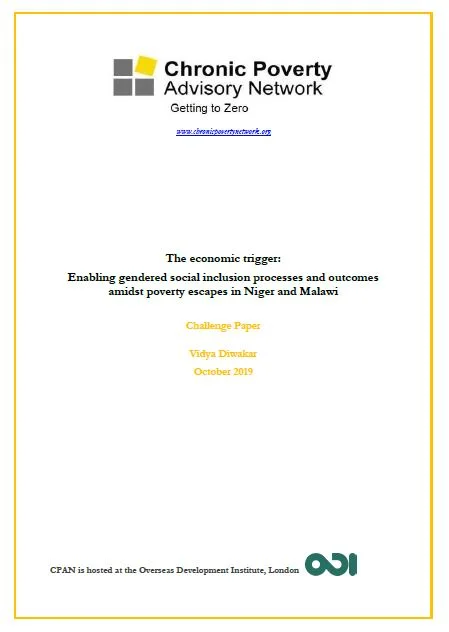
This study explores social inclusion of poor women and children as both process and outcome in Niger and Malawi.
This report is a synthesis of the research developed in the framework of the project 'Disability, poverty and poverty dynamics: a preliminary analysis of panel data, policies and politics in Bangladesh' and aims to summarises its main finding and policy implications.

Persons with disability are often considered as a specific chronic poverty group. However, little empirical evidence exists for developing countries on the size of disabled population. Even less is known about the interface between disability and poverty. The present study aims to provide statistically robust analysis of the state of disability and its interface with poverty and vulnerability through different pathways.
Authors: Binayak Sen, Mainul Hoque
This paper focuses on the economic empowerment of poor and very poor women and girls. Advice on the practical interventions to enable WEE is rarely disaggregated by the intersecting inequalities that magnify poverty and inequality. As such, it fails to address the significant barriers to WEE for chronically poor women. This paper seeks to fill this gap in the literature.
This report assesses drivers of the economic empowerment of chronically poor women and girls in rural Bangladesh and rural Nigeria. The focus is on drivers related to assets, both intangibly in terms of education, and tangibly in terms of ownership of consumption and productive assets including land.
Thispaper provides the latest analysis of development policies and programmes that work best for the poorest people. It has a particular focus on the poorest women and girls and it also focuses on the work carried out by a number of leading donors, assessing the extent to which they attempt to reach the poorest, and among them the poorest women and girls.
This briefing paper provides recommendations for stakeholders on how toimprove accountability and performance in local governance through a local governance performance index (LGPI) at the district level in Tanzania.
Authors: Rachel Hayman, Anna Mdee and Patricia Tshomba
This working paper details the process of creating a Local Governance Performance Index (LGPI) in Mvomero and Kigoma-Ujiji Districts of Tanzania and of studying its applicability.
Authors: Anna Mdee, Patricia Tshomba & Andrew Mushi
This paper explores the relationship between disability and poverty dynamics in rural Bangladesh drawing from 293 life-history interviews conducted by the author and a small team of researchers in 2007. The aim of the paper is to use existing life-history interviews to provide initial insights into the relationship between poverty and disability in Bangladesh.
Author: Peter Davis
This briefing paper summarises findings around the key questions of what ‘development’ means at the local level, who is responsible for it, and how local government can be held to account in practice. Findings are illustrated with selected quotes from interviews, focus groups and workshops, which demonstrate the challenges that need to be overcome to design and implement a performance index.
This paper explores the links between poverty and disability drawing from 60 qualitative life-history interviews conducted in rural Bangladesh, in 48 households, in three districts, in March 2016. The paper provides insights into the relationship between poverty and disability with the aim of informing policy and practice concerned with both reducing poverty and improving the life chances of people with disabilities.
Author: Peter Davis

The focus of the paper is on persistently poor women with disabilities in Bangladesh. It seeks to contribute to the disability and chronic poverty policy discourse and work towards developing effective poverty reduction measures by investigating daily activities and coping strategies of poor persons with disabilities.
Author: Vidya Diwakar
Efforts to tackle discrimination in access to basic services have shown mixed results in different country settings. This study examines the positive and negative outcomes attributed to anti-discrimination measures adopted in different country contexts and analyses the factors contributing to these outcomes, with a specific focus on anti-discrimination measures in education.
The selection of indicators for the creation of an index is critical if it is to be used as a mechanism to hold local government to account. Clear lines of responsibility and accountability need to be incorporated into the selection of indicators so the index can be applied at the local level.
This report is a rigorous review of 470 pieces of evidence on the effectiveness of anti-discrimination measures in low and middle-income countries. The review focuses on women and girls, children, young people, disabled people, marginalised ethnic and racial groups and marginalised castes.
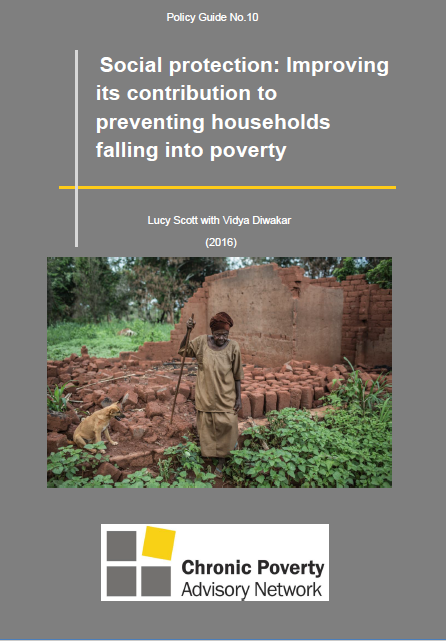
The guide highlights the potential trade-offs that policy-makers, programme designers and implementers face in using social protection with the specific objective of preventing impoverishment.
Authors: Lucy Scott and Vidya Diwakar
Urbanisation and labour force participation can be powerful drivers of women economic empowerment. This paper reviews the empowering and disempowering effects of urbanisation on the the main areas of work performed by women in cities and analyses the interventions which have been implemented to support the different types of female urban livelihoods
A performance index for local governance in Tanzania needs to provide a clear indication of how effectively local government and partners are delivering public services, supporting livelihoods and ensuring peace and security. This paper sets out the context of good governance, local governance, accountability and local service delivery in Tanzania.
Authors: Anna Mdee and Lisa Thorley
One of the most powerful ideas in development in recent years has been good governance. This review of available evidence considers how the performance of local governance can be improved in relation to the better delivery of services, through the use of a local governance performance index. It also considers how the public tracking of locally meaningful measures of governance can be used to improve the accountability of local government bureaucracies and politicians.
Authors: Anna Mdee and Lisa Thorley
This policy guide looks at evidence from social protection programmes with innovative designs that combine different interventions, either following a graduation approach or by building integrated social protection systems.
Authors: Chiara Mariotti, Martina Ulrichs and Luke Harman