This report introduces the concept of ‘Growth from below’ and analyses policies and programmatic approaches that directly help people out of poverty through the informal economy, women’s economic empowerment and the inclusion of most marginalised groups, agriculture, the rural non-farm economy and migration.
Read MoreLeave No One Behind in progress to the Sustainable Development Goals: Priority actions for governments by 2020

The 2014–15 Chronic Poverty Report: the road to zero extreme poverty argued that three objectives had to be achieved to get to zero poverty: chronic poverty had to be tackled; impoverishment had to be stopped; and escapes from poverty needed to be sustained. The report identified 14 policy areas that could be critical for the eradication of extreme poverty and leaving no one behind in the process. These can also be clustered into four pillars: human development, pro-poorest growth, transformative social change and resilience.
This paper provides a reasonably comprehensive basis for identifying policies that will contribute to leaving no one behind, since the chronically poor are, by definition, those who are getting left behind in the process of development. Of course, among the chronically poor are those who are able to make progress and sustain escapes from poverty; there are also those who are stuck on the consumption floor, which has barely moved in several decades, some of whom may be experiencing ‘intersecting inequalities’ (those pertaining to different attributes like age, religion, gender, embodied in the same person) – or, in simpler terms, those who experience multiple disadvantages.
This paper explores context through a re-categorisation of countries using income levels, institutional fragility and progress on poverty, and an analysis of countries’ policy frameworks in 2015. It then explores the above priorities in context, and in each policy area outlines key measures that will underpin progress and enhance access for the poorest and most marginalised.
The aim of this analysis is to stimulate debate as to what policy mix is appropriate, necessary and desirable in different country circumstances. Once policies have been selected, policy consistency over time, as well as their sequencing; cross-government coordination to ensure delivery of the right combinations; and multi-stakeholder partnerships for implementation are indispensable tools to reach the objective of LNOB and achieve the SDGs for all. Governments vary in the extent to which they have such mechanisms in place and allow them to influence policy and implementation.
Authors: Andrew Shepherd and Kate Bird with Moizza Binat Sarwar
Related Content

Poverty dynamics, poverty dynamics, Pro-poorest Growth, Climate resilience, Climate change, Growth Papers, growth from below, Zambia
Harnessing Growth Poles for Poverty Reduction and Climate Resilience in Zambia
Poverty dynamics, poverty dynamics, Pro-poorest Growth, Climate resilience, Climate change, Growth Papers, growth from below, Zambia
Poverty dynamics, poverty dynamics, Pro-poorest Growth, Climate resilience, Climate change, Growth Papers, growth from below, Zambia

This paper explores the differences between the qualitative life history interview approach and the quantitative expenditures approach to analysing poverty incidence and poverty dynamics in Rwanda.

This paper presents the results of the qualitative data collection undertaken in Rwanda in 2017 and 2019 as part of a Q-squared analysis of poverty dynamics. It seeks to build on earlier work by da Corta et al. (2018a and 2018b) and Simons (2018) to understand the reasons for the slowdown in poverty reduction in Rwanda from 2014.
This brief outlines countries, sub-national areas and populations in or near poverty that need to be explicitly prioritised in the response to coronavirus.
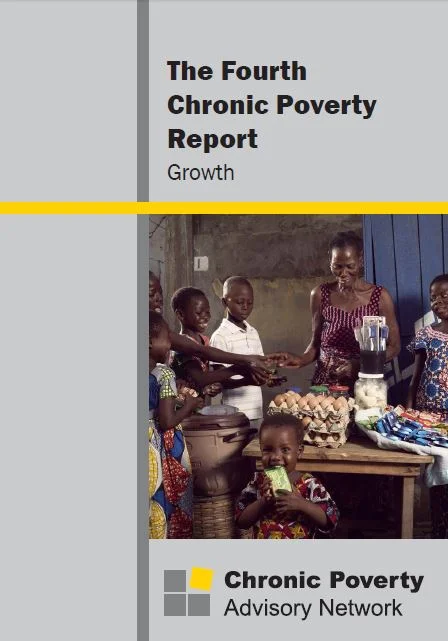
This report introduces the concept of ‘Growth from below’ and analyses policies and programmatic approaches that directly help people out of poverty through the informal economy, women’s economic empowerment and the inclusion of most marginalised groups, agriculture, the rural non-farm economy and migration.
This briefing note summarises the findings of the Chronic Poverty Advisory Network's (CPAN) forthcoming Chronic Poverty Report on Growth and introduced the concept of Growth from Below (GfB)
The contribution of this paper is to establish knowledge of how and whether the observed economic growth in the past has been pro-poor and identify what are the enablers and constraints of poverty reduction in Rwanda.
The specific focus of this report is to analyse the movements of poverty and its linkages with economic growth for 2001-2010 period.
This study seeks to provide a detailed understanding of poverty dynamics in Malawi. This has not been done previously due to lack of nationally representative panel data.
Growth Papers, CPR4, Poverty dynamics, Poverty escapes, USAID, KDAD, Pro-poorest Growth, India, Conflict
Growth Papers, CPR4, Poverty dynamics, Poverty escapes, USAID, KDAD, Pro-poorest Growth, India, Conflict
This paper presents initial findings on the relationships between growth, growth incidence across the income distribution and those poverty dynamics in India, a set of relationships which has never previously been investigated.
Pro-poorest growth, defined as a relatively greater proportion of income gain from growth by the poorest compared to the average, may be necessary to achieve the first Sustainable Development Goal target of eradicating extreme poverty: this paper argues that it is likely to be, and that some countries have had at least episodes of pro-poorest growth.
Authors: Andrew Shepherd, Chiara Mariotti, and Laura Rodriguez-Takeuchi

This paper explores agroecology as an alternative approach to agricultural transformation, offering low-input but knowledge intensive agriculture as a more inclusive and sustainable way forwards.
Authors: Anna Mdee, Alex Wostry, Andrew Coulson & Janet Maro
This paper addresses that knowledge gap by applying new analytical techniques to existing data, helping to assess the impact of different types of pro-poor interventions in Fragile and Conflict Affected States (FCAS)
Author: Andrew Shepherd, Vidya Diwakar, Georgina Sturge
The purpose of this Working Paper is to explore a menu of policy recommendations to support smallholder agriculture, the rural nonfarm economy and casual wage labour. Developing country governments could use these recommendations to think through their policy-making decisions and ensure the poorest people participate in economic growth on good terms, such that they can sustainably escape poverty.
Author: Andrew Shepherd
The purpose of this Working Paper is to explore a menu of policy recommendations that developing country governments can use to think through their policy-making decisions and ensure the poorest people participate in economic growth on good terms, such that they can sustainably escape poverty.
Authors: Chiara Mariotti and Andrew Shepherd
Pro-poorest economic growth is necessary to improve all poverty dynamics and to eradicate extreme poverty. This Working Paper outlines what pro-poorest growth is and why it is necessary, building on the concept of pro-poor growth popularised in the 2000s.
Author: Chiara Mariotti
The international community has committed to Leaving No One Behind. This means poverty eradication shouldn’t count as such if certain people are systematically excluded from it. Growth is a key means of implementing these commitments. So how can growth occur in a way which includes the poorest on good terms? These were the premises of the Conference ‘Incorporating Pro-Poorest Growth in the SDGs: Moving Beyond the MDGs’ implemented by CPAN and the Asian Development Bank in Manila in April 2016.

The objective of this policy guide is to provide policymakers and programme designers with an up-to-date view of what needs to be done to include the poorest people in financial services, and by doing so make a dent in their poverty. It selects savings and insurance as two aspects of financial services that are most likely to build poor people’s resilience in the face of the multiple risks they face – a necessary precursor to any investments they might make to get out of poverty.

This policy brief provides a situation analysis on financial inclusion in Nigeria, including a short analysis of how it may figure in chronic poverty, and processes of escaping poverty and impoverishment. It also goes on to assess the relevance of the four potential promising avenues identified in the global CPAN Financial inclusion Policy Guide (Smith et al 2015) for including the poorest people in Nigeria. This leads to a commentary on the e Nigerian Financial Inclusion Strategy.

This policy guide aims at identifying those interventions that best promote entrepreneurship among the poor in a way that puts them on trajectories out of poverty. For some, these interventions can contribute to sustained poverty escapes; for others, they mean faster upward mobility to the poverty line.

This policy brief looks at the two key challenges for a pro-poor private sector development strategy: the creation of decent jobs; and the promotion of (formal and informal) micro, small and medium enterprises (MSMEs) with the potential for growth and transformation.