Growing equitably, sustainably and leaving no one behind: a policy agenda for developing countries/for the poorest
The five years 2016-2020 will be critical to setting the direction for implementing the SDGs. If sufficient countries do have adequate policy frameworks and implementation processes by 2020, the likelihood of achieving the ambitious goals for eradication of poverty and deprivation will be significantly enhanced. The period 2016-2020, will be key to determine the extent to which the Sustainable Development Goals (SDGs), and in particular the Poverty Eradication target will be met by 2030.
Whereas there are areas of policy where there is a lot of evidence available on tackling chronic poverty, stopping impoverishment and sustaining escapes from extreme poverty – especially on the role of human development - there are other important policy areas where evidence is thinner. These include how to include the poorest in economic growth.
As part of the 'Resilience and Poverty Escapes' project, CPAN ihas recently published the 4th edition of the Chronic Poverty Report series -The Chronic Poverty Report on Growth - which analyses the relation between poverty and pro-poor growth. The report aims to put in front of economic policymakers in developing countries and international agencies evidence about the type of growth and the policies and interventions that will best allow the poor to escape poverty and stay out of it through growth.
Moving from our previous analysis and evidence from a growing database of country studies of poverty dynamics, it emerges that most people sustaining their escapes from poverty through small, usually informal, investments by individuals and households, enabled or disadvantaged by their working environments. This is what we called ‘Growth from Below’. This is the ‘big idea’ embedded in this report: most governments promote ‘growth from above’, involving large, formal investments, while most people escape poverty through ‘growth from below’. As such, this report analyses policies and programmatic approaches that directly help people out of poverty through the informal economy, women’s economic empowerment and the inclusion of most marginalised groups, agriculture, the rural non-farm economy and migration
The research that has led to the Chronic Poverty Report on Growth has included:
A study of poverty dynamics and growth incidence, investigating the relationships between the distribution of benefits from growth (via Growth Incidence Curves) and poverty dynamics, and joint and separate drivers of the two. This study would draw attention to both policy and non-policy drivers. A series of country reports that look at the relationship between household-level poverty dynamics and patterns of growth incidence amongst the poorest people in Tanzania, Rwanda, Ethiopia, Malawi, Cambodia, Nepal, Philippines, Niger, Uganda, Bangladesh, India, Pakitan. See below to browse these studies.

The contribution of this paper is to establish knowledge of how and whether the observed economic growth in the past has been pro-poor and identify what are the enablers and constraints of poverty reduction in Rwanda.
The specific focus of this report is to analyse the movements of poverty and its linkages with economic growth for 2001-2010 period.
This study seeks to provide a detailed understanding of poverty dynamics in Malawi. This has not been done previously due to lack of nationally representative panel data.
This paper presents initial findings on the relationships between growth, growth incidence across the income distribution and those poverty dynamics in India, a set of relationships which has never previously been investigated.
A series of studies on women’s economic empowerment, with empirical analysis of Bangladesh and Nigeria, as well as an analysis of donor initiatives for chronically poor women.
This paper focuses on the economic empowerment of poor and very poor women and girls. Advice on the practical interventions to enable WEE is rarely disaggregated by the intersecting inequalities that magnify poverty and inequality. As such, it fails to address the significant barriers to WEE for chronically poor women. This paper seeks to fill this gap in the literature.
This report assesses drivers of the economic empowerment of chronically poor women and girls in rural Bangladesh and rural Nigeria. The focus is on drivers related to assets, both intangibly in terms of education, and tangibly in terms of ownership of consumption and productive assets including land.
Thispaper provides the latest analysis of development policies and programmes that work best for the poorest people. It has a particular focus on the poorest women and girls and it also focuses on the work carried out by a number of leading donors, assessing the extent to which they attempt to reach the poorest, and among them the poorest women and girls.
More background information and studies on the report can be found in the the blog post Economic Growth, the poorest and the 4th Chronic Poverty Report - a discussion which summaries the discussions held at the Technical Workshop for the 4th Chronic Poverty Report at ODI, in London, on the 19th June.

The Chronic Poverty Report 2023: Pandemic Poverty sets out to investigate the highly negative effects of the Covid-19 restrictions, and most importantly, the success or otherwise of the measures pursued to mitigate those effects on people in and near poverty.
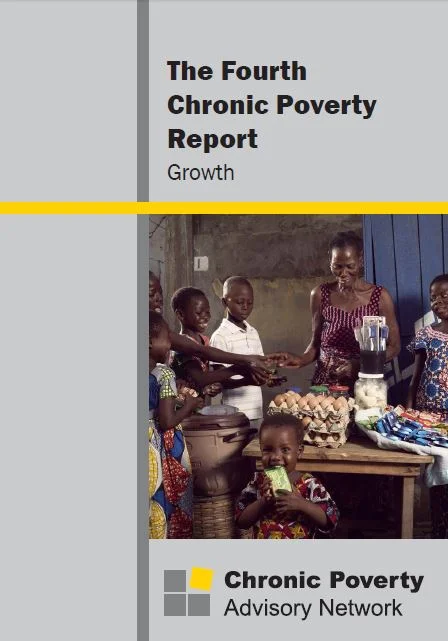
This report introduces the concept of ‘Growth from below’ and analyses policies and programmatic approaches that directly help people out of poverty through the informal economy, women’s economic empowerment and the inclusion of most marginalised groups, agriculture, the rural non-farm economy and migration.

This report demonstrates that escaping from poverty is not a one-way street – many families slide back below the poverty line because of factors such as ill-health, job loss and natural disasters.
Authors: Andrew Shepherd, Lucy Scott, Chiara Mariotti, Flora Kessy, Raghav Gaiha, Lucia da Corta, Katharina Hanifnia, Nidhi Kaicker, Amanda Lenhardt, Charles Lwanga-Ntale, Binayak Sen,
Bandita Sijapati, Tim Strawson, Ganesh Thapa, Helen Underhill, Leni Wild.
The report has looked at the large numbers of programmes and schemes in various forms that over the years aimed at poverty alleviation in India, some targeting specific groups, to try and identify why they have not succeeded to the desired extent. Design flaws, weak implementation, inadequate provision of funds, and the inability of the poor to access scheme benefits, are amongst many factors identified and analyzed.

The overall message of the second Uganda Chronic Poverty Report is that chronically poor people are hardly on the policy radar. It emphasises the need for more political commitment in Uganda to address the issue of chronic poverty.
Authors: Development Research and Training (DRT) and the Chronic Poverty Research Centre (CPRC).
This report on Chronic Poverty in Uganda is intended to inform policy makers and implementers (both within government and civil society), so that the interests of the very poorest in our country are reflected in national priorities.
Bangladesh has come out of the "shadow of famine", the problem of starvation still persists. Accurate figures are not available for urban areas, but in effect between 25 to 30 million of the country's citizens are chronically poor. Here we review the present status and situation of the poorest, analyse the main factors that keep them in poverty and identify the types of policy that can help them escape deprivation and gain their full rights as citizens of an increasingly prosperous and high-stepping country.

The report is about the estimated 320 to 443 million people who live trapped in chronic poverty - people who will remain poor for much or all of their lives and whose children are likely to inherit their poverty. The chronically poor experience multiple deprivations, including hunger, undernutrition, illiteracy, lack of access to safe drinking water and basic health services, social discrimination, physical insecurity and political exclusion. Many will die prematurely of easily preventable deaths.
The first Chronic Poverty Report examines what chronic poverty is and why it matters, who the chronically are, where they live, what causes poverty to be persistent and what should be done about it. A section of regional perspectives looks at the experience of chronic poverty in sub-Saharan Africa, South Asia, Latin America and the Caribbean, transitional countries and China. A statistical appendix brings together data on global trends on chronic poverty.
Photo credit: Harvesting. India. Photo: © World Bank / Curt Carnemark