


Featured Research
Ensuring Escapes from Poverty are Sustained in Rural Bangladesh: Why some households are able to escape poverty and remain out of it while others escape poverty only to return to living in it again.



To complement our Covid-19 Poverty Monitor, we’ve gathered a list of helpful resources for those developing policies needed to address the negative social and economic impacts of the pandemic. Our Bangladesh Covid-19 Poverty Monitor is coming soon.
CPAN PUBLICATIONS ON BANGLADESH


The brief presents findings around health shocks and health as a resilience capacity from a series of 11 country studies on drivers of poverty dynamics in both Africa and Asia.
This report is a synthesis of the research developed in the framework of the project 'Disability, poverty and poverty dynamics: a preliminary analysis of panel data, policies and politics in Bangladesh' and aims to summarises its main finding and policy implications.

Persons with disability are often considered as a specific chronic poverty group. However, little empirical evidence exists for developing countries on the size of disabled population. Even less is known about the interface between disability and poverty. The present study aims to provide statistically robust analysis of the state of disability and its interface with poverty and vulnerability through different pathways.
Authors: Binayak Sen, Mainul Hoque
This report assesses drivers of the economic empowerment of chronically poor women and girls in rural Bangladesh and rural Nigeria. The focus is on drivers related to assets, both intangibly in terms of education, and tangibly in terms of ownership of consumption and productive assets including land.
This paper explores the relationship between disability and poverty dynamics in rural Bangladesh drawing from 293 life-history interviews conducted by the author and a small team of researchers in 2007. The aim of the paper is to use existing life-history interviews to provide initial insights into the relationship between poverty and disability in Bangladesh.
Author: Peter Davis
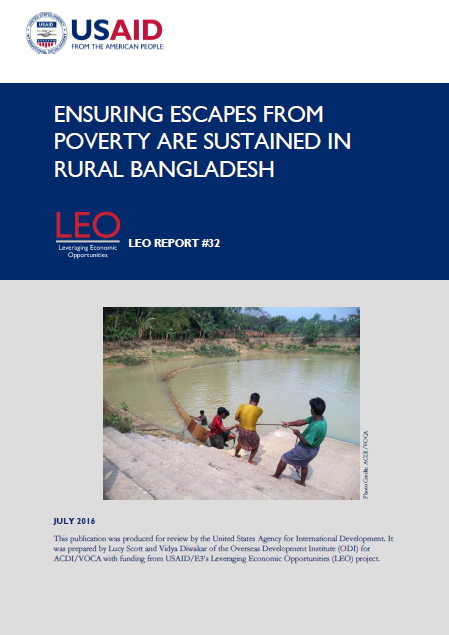
Bangladesh has experienced substantial reductions in both extreme poverty and poverty. The proportion of the population living below the national extreme poverty line has reduced from 50 percent in 1991 to 18 percent in 2010. However, some households escape poverty only to live at a level just above the poverty line. They therefore remain vulnerable to slipping into poverty in the event of a shock or stressor, such as an episode of ill-health or a flood. The specific focus of this report is on “transitory poverty escapes”: a term referring to households that successfully escape from poverty only to return to living in it once again i.e. they become re-impoverished.
Authors: Lucy Scott and Vidya Diwakar
This paper explores the links between poverty and disability drawing from 60 qualitative life-history interviews conducted in rural Bangladesh, in 48 households, in three districts, in March 2016. The paper provides insights into the relationship between poverty and disability with the aim of informing policy and practice concerned with both reducing poverty and improving the life chances of people with disabilities.
Author: Peter Davis

The focus of the paper is on persistently poor women with disabilities in Bangladesh. It seeks to contribute to the disability and chronic poverty policy discourse and work towards developing effective poverty reduction measures by investigating daily activities and coping strategies of poor persons with disabilities.
Author: Vidya Diwakar

This National Policy Brief highlights the improvements that have been made in the poorest people's incomes, levels of education and health in Bangladesh and sets out the policies that need to be focused on in order to sustain and expand this progress.
Authors: Binayak Sen and Zulfiqar Ali
Bangladesh has come out of the "shadow of famine", the problem of starvation still persists. Accurate figures are not available for urban areas, but in effect between 25 to 30 million of the country's citizens are chronically poor. Here we review the present status and situation of the poorest, analyse the main factors that keep them in poverty and identify the types of policy that can help them escape deprivation and gain their full rights as citizens of an increasingly prosperous and high-stepping country.
CPAN BLOGS ON BANGLADESH
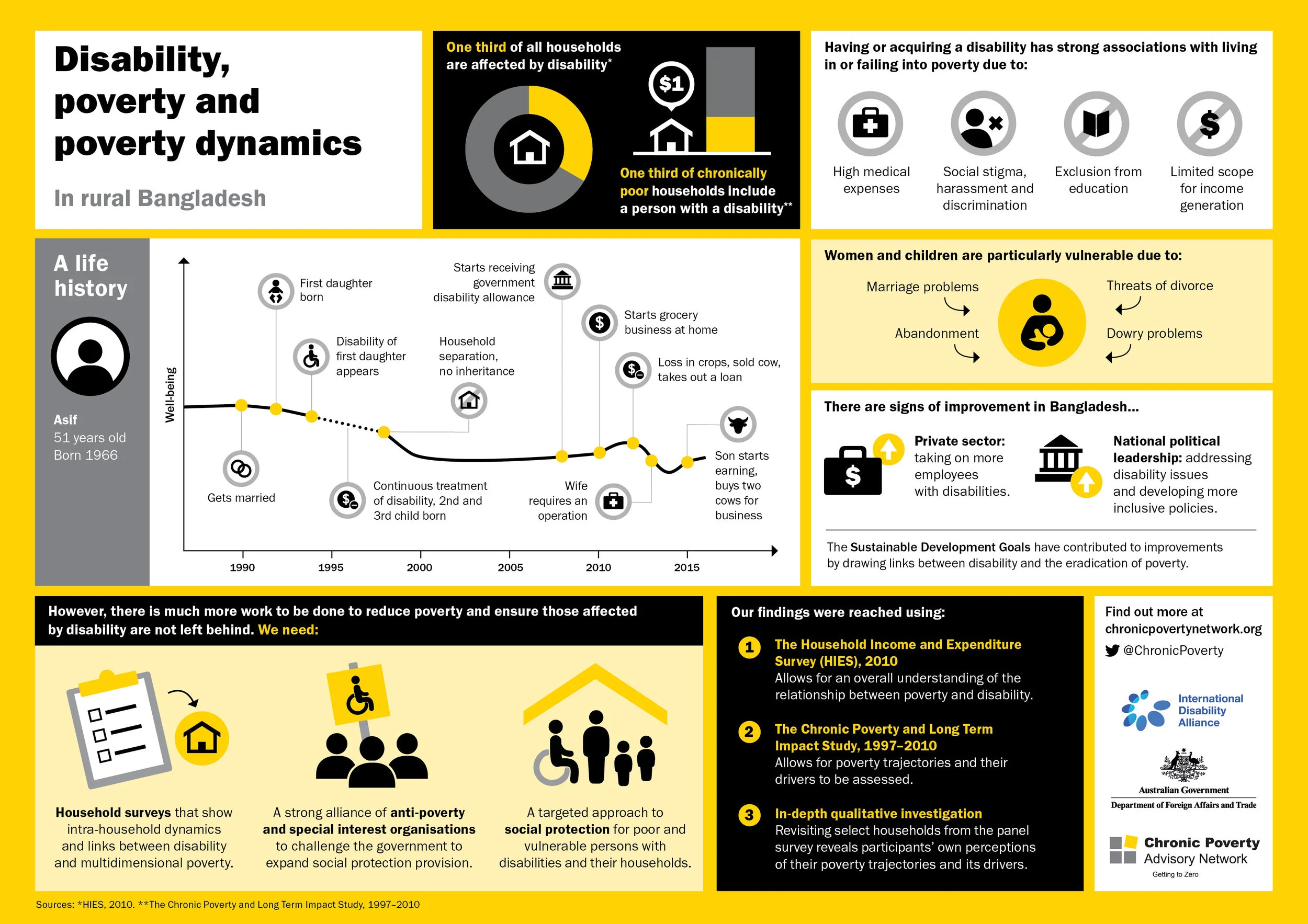
Having or acquiring a disability has strong associations with living in or failing into poverty. In the framework of the project 'Disability, poverty and poverty dynamics: a preliminary analysis of panel data, policies and politics in Bangladesh' CPAN has has found important signs of improvement in Bangladesh.

This was the question asked by a three-year research project, led by ODI, in collaboration with partners in Afghanistan, Bangladesh, India and Nepal. This blog discusses the questions and ideas that came out of a recent workshop on this project.
World Bank