Recent research by ODI CPAN, commissioned by the USAID Center for Resilience, investigated the resilience of households above the poverty line in Uganda and the Philippines. The research aimed to isolate the extent to which being “near-poor” makes households vulnerable to falling into poverty in the future. The study also explored whether the same sources of resilience that protect against transitory poverty escapes and promote sustained escapes from poverty function in similar ways for the near-poor and households vulnerable to future poverty. In particular, it investigated whether households that sustainably escape poverty also sustainably escape vulnerability, and if not, what are the drivers associated with these different trajectories that can help build resilience? As sustained poverty escapers that also leave vulnerability behind are likely to have become more resilient, examining these sources of resilience even among the near-poor is important in developing effective poverty reduction strategies.
Analysis of the Uganda National Panel Survey from 2009/10-2013/14 and the Philippines Family Income and Expenditure Survey from 2003-2009 reveals that as many as 77 percent of Ugandan households and 55 percent of Filipino households had per capita income above the poverty line but under two times the national poverty line in at least one of the survey years. Vulnerability was also high, with as much as 59 percent in Uganda in 2013/14 and 51 percent in the Philippines in 2009 estimated as being vulnerable to poverty, or more likely than the typical person to be poor in the subsequent period. In most cases, vulnerability status encompasses poverty status, meaning that poor households were also highly likely to be vulnerable, though there was a much larger share as well of households that were not poor, yet vulnerable.
The study suggests that policies should acknowledge the varied drivers of sustained escapes when measured by poverty but also vulnerability. This is because an assessment of vulnerability dynamics can help identify resilience capacities of households, by considering future expected poverty in addition to present poverty dynamics. Such an assessment suggests that there may be more drivers associated with sustained escapes from vulnerability than those for escaping poverty sustainably among the near-poor across countries. In Uganda, secondary education and some economic diversification from agriculture, particularly for households at higher levels of income, reduces vulnerability to poverty significantly. In the Philippines, a level of income which enables good use to be made of loans, and enables greater health expenditure and increased dependency levels while avoiding impoverishment emerges as important in promoting resilience.
At the same time, there are factors that undermine these sustained escapes and processes of resilience-building. Regression results indicate factors like alcohol consumption in the Philippines and urban residence in Uganda pose constraints to sustained escapes from vulnerability among the near-poor. The fieldwork in both countries also indicated that transitory escapes from poverty and impoverishment is more often a result of multiple shocks, though some single shocks can also impoverish by impairing resilience capacities. Examples range from high-intensity typhoons in the Philippines, to severe disability in Uganda. Cash transfers significantly help with recovery from such devastating shocks, though should not operate in isolation.
In this context, there are certain enabling conditions for the near-poor to continue to make progress and build resilience. These include a substantial formal sector, more commercialized agriculture, reduced dependency burdens, improved conditions for female-headed households and assistance to poor and near-poor households. Assistance, whether in the form of cash transfers or remittances, is associated with increasing the likelihood of sustained escapes among the near-poor in Uganda and the Philippines, respectively. However, at the moment, cash transfers remain mainly targeted to households that are already poor. A renewed focus on social protection and assistance for the poorest but also extended to households near the poverty line would do well in these contexts. At the same time, assistance in the form of remittances and help from relatives and friends is also about social capital and networks, reflecting a social structural component of mobility that is critical in building resilience and important to consider in programming. Supporting agency embedded within these kinship structures is a step towards improving resilient outcomes over time for near-poor households.
Authors: Vidya Diwakar and Andrew Shepherd
This publication appears also on the Agrilinks website

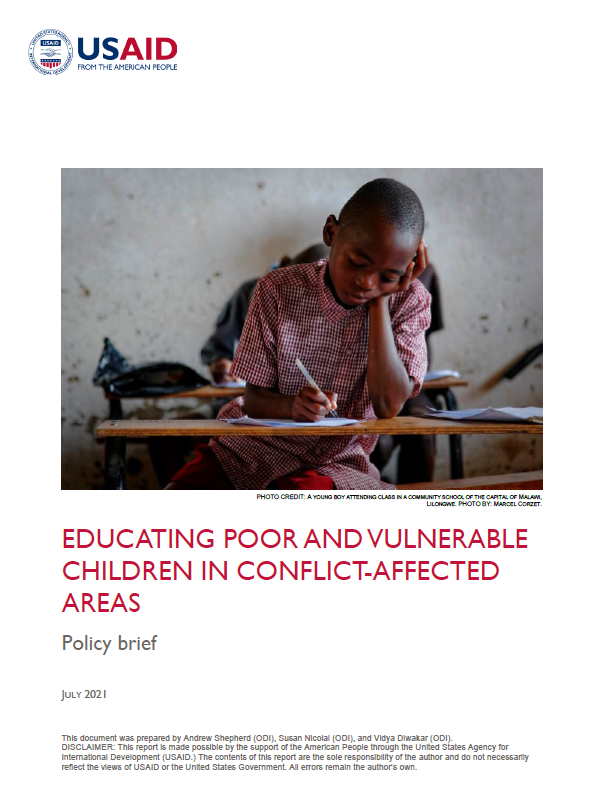
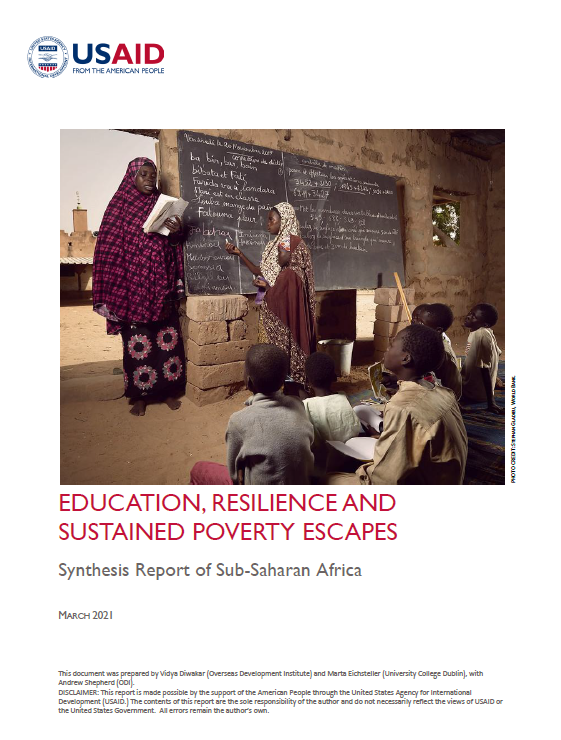
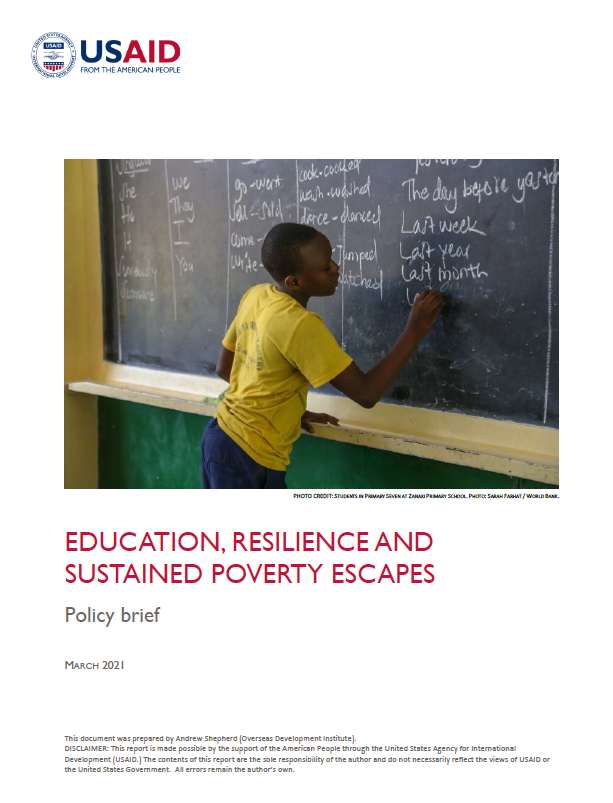
Recent research by ODI CPAN, commissioned by the USAID Center for Resilience, investigated the resilience of households above the poverty line in Uganda and the Philippines.
This report introduces the concept of ‘Growth from below’ and analyses policies and programmatic approaches that directly help people out of poverty through the informal economy, women’s economic empowerment and the inclusion of most marginalised groups, agriculture, the rural non-farm economy and migration.

The brief presents findings around health shocks and health as a resilience capacity from a series of 11 country studies on drivers of poverty dynamics in both Africa and Asia.
This brief draws on results of mixed methods research in Malawi, to offer policy and programming implications for sustained poverty reduction.
This research examined why some households in Malawi escape and remain out of poverty (sustainable poverty escape), while other households escape it only to fall back into poverty (transitory poverty escape) and still others descend into poverty for the first time (impoverishment).
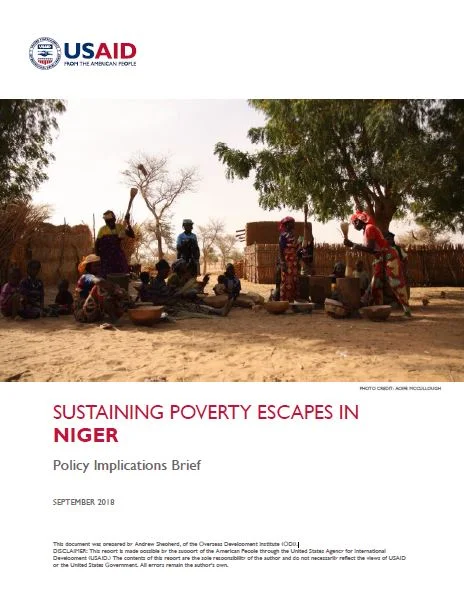
This policy brief highlights the policy recommendations to contribute to achieve sustained escapes out of poverty in Niger
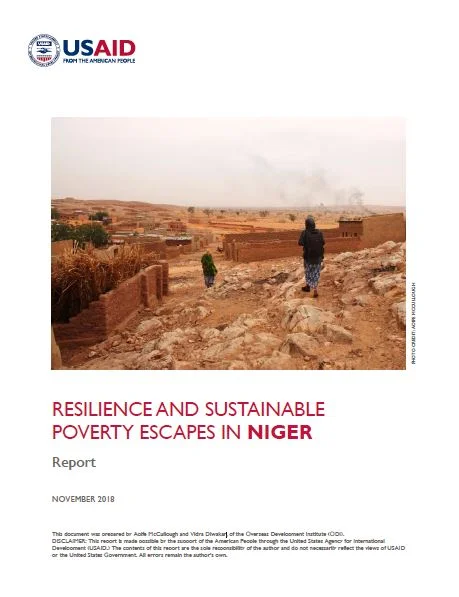
The focus of this report is on resilience and household poverty dynamics in Niger, specifically escapes and descents, with a focus on what explains why some households escape poverty and remain out of poverty, while other households escape poverty only to fall back into poverty.
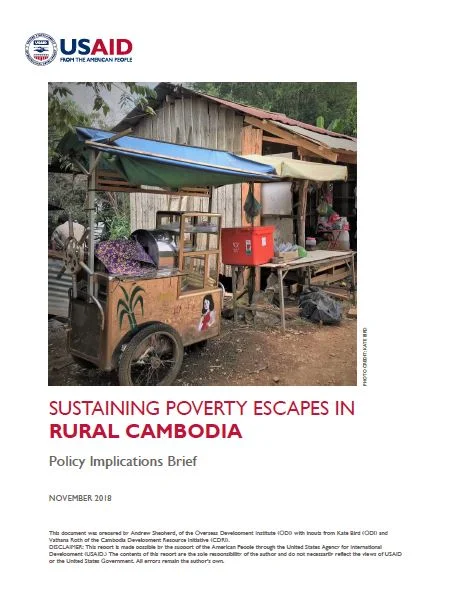
The focus of this brief is on what these findings may mean for interventions and approaches in Cambodia that aim to enable poor households to escape from poverty and to maintain that escape over time
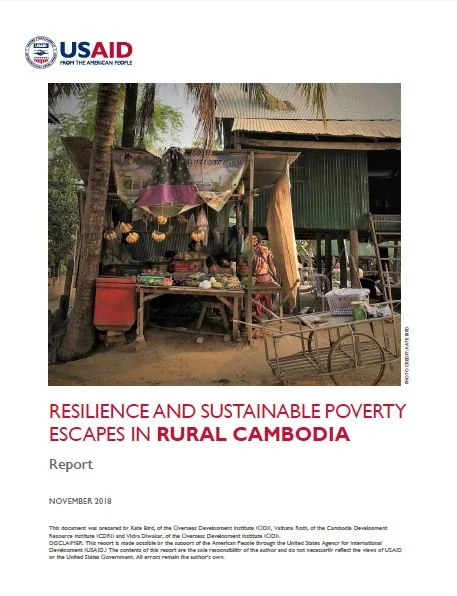
The focus of this report is on household poverty escapes in rural Cambodia and explains why some households escape poverty and remain out of poverty (sustainable poverty escape, or resilience), while other households escape poverty only to fall back into poverty (transitory poverty escape) and still other descend into poverty for the first time (impoverishment
The contribution of this paper is to establish knowledge of how and whether the observed economic growth in the past has been pro-poor and identify what are the enablers and constraints of poverty reduction in Rwanda.
The specific focus of this report is to analyse the movements of poverty and its linkages with economic growth for 2001-2010 period.
This study seeks to provide a detailed understanding of poverty dynamics in Malawi. This has not been done previously due to lack of nationally representative panel data.
This paper presents initial findings on the relationships between growth, growth incidence across the income distribution and those poverty dynamics in India, a set of relationships which has never previously been investigated.
To date, there is little knowledge about what differentiates a sustained escape from a temporary escape, or these from chronic poverty. The principal objective of this research is to develop an understanding of why some households managed to sustain their escapes out of extreme poverty while others fell back into poverty.
This brief draws on results of mixed methods research in Tanzania, to offer policy and programming implications for sustained poverty reduction.
This report focuses on household poverty escapes in Tanzania and explains why some households escape poverty and remain out of poverty (sustainable poverty escape, or resilience), while other households escape poverty only to fall back into poverty (transitory poverty escape) or descend into poverty for the first time (impoverishment).
This policy brief draws on results of mixed methods research in the Philippines, to offer policy and programming implications for sustained poverty reduction.
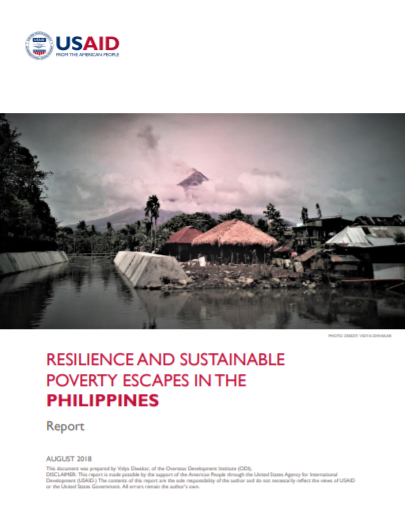
This report investigates the drivers of sustained and transitory escapes from poverty in the Philippines

The focus of this brief is on what those findings may mean for interventions and approaches in Kenya that aim to enable poor households to escape poverty and remain out of it.
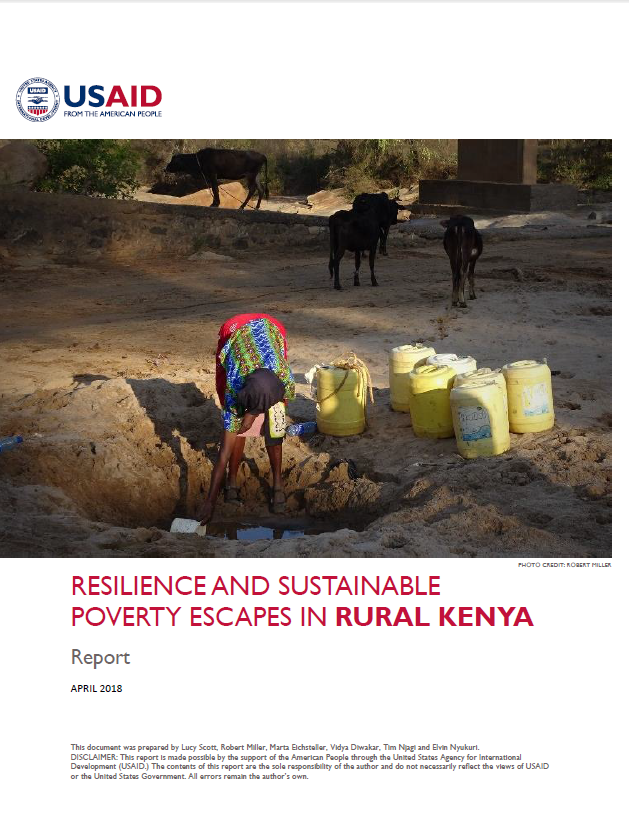
The report investigates the resources (land, livestock, and assets), attributes (household composition and education level), and activities (including jobs and engagement in non-farm activities) of households that enable them to escape poverty sustainably and minimise the likelihood of returning to living in poverty again
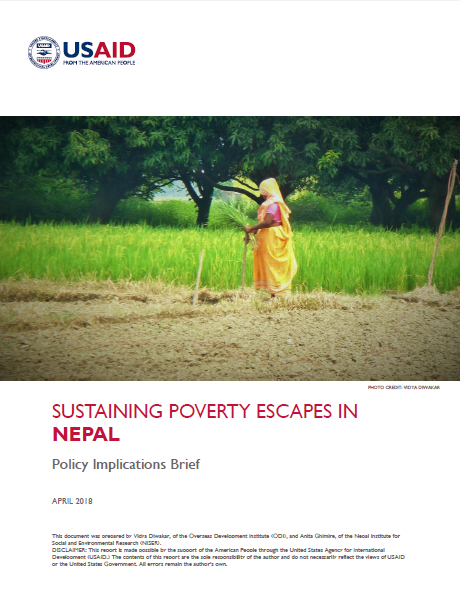
This brief draws on results of mixed methods research in Nepal to offer policy and programming implications for sustained poverty reduction and it advocates a portfolio response to poverty reduction that incorporates a sound understanding of poverty dynamics
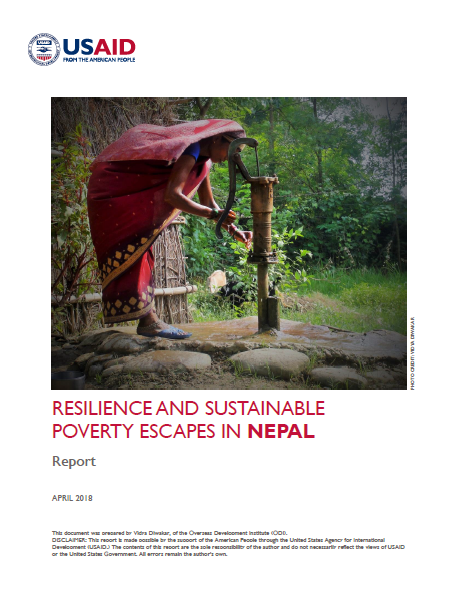
The focus of this report is on household poverty escapes and what explains why some households escape poverty and remain out of poverty, while other households escape poverty only to fall back into poverty and still other descend into poverty for the first time.
This paper focuses on the economic empowerment of poor and very poor women and girls. Advice on the practical interventions to enable WEE is rarely disaggregated by the intersecting inequalities that magnify poverty and inequality. As such, it fails to address the significant barriers to WEE for chronically poor women. This paper seeks to fill this gap in the literature.
This report assesses drivers of the economic empowerment of chronically poor women and girls in rural Bangladesh and rural Nigeria. The focus is on drivers related to assets, both intangibly in terms of education, and tangibly in terms of ownership of consumption and productive assets including land.
Thispaper provides the latest analysis of development policies and programmes that work best for the poorest people. It has a particular focus on the poorest women and girls and it also focuses on the work carried out by a number of leading donors, assessing the extent to which they attempt to reach the poorest, and among them the poorest women and girls.
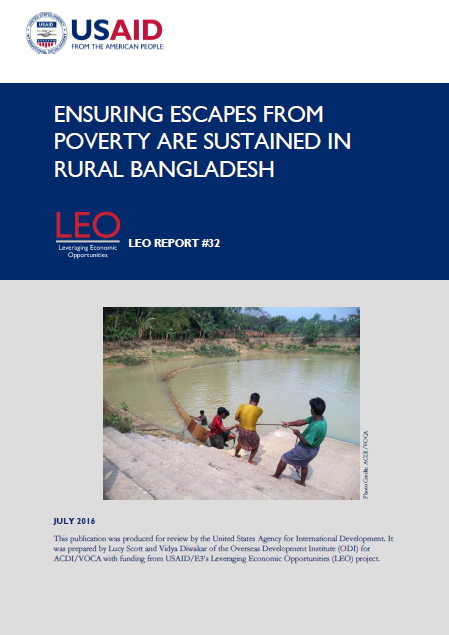
Bangladesh has experienced substantial reductions in both extreme poverty and poverty. The proportion of the population living below the national extreme poverty line has reduced from 50 percent in 1991 to 18 percent in 2010. However, some households escape poverty only to live at a level just above the poverty line. They therefore remain vulnerable to slipping into poverty in the event of a shock or stressor, such as an episode of ill-health or a flood. The specific focus of this report is on “transitory poverty escapes”: a term referring to households that successfully escape from poverty only to return to living in it once again i.e. they become re-impoverished.
Authors: Lucy Scott and Vidya Diwakar

The Chronic Poverty Report 2023: Pandemic Poverty sets out to investigate the highly negative effects of the Covid-19 restrictions, and most importantly, the success or otherwise of the measures pursued to mitigate those effects on people in and near poverty.
This report introduces the concept of ‘Growth from below’ and analyses policies and programmatic approaches that directly help people out of poverty through the informal economy, women’s economic empowerment and the inclusion of most marginalised groups, agriculture, the rural non-farm economy and migration.

This report demonstrates that escaping from poverty is not a one-way street – many families slide back below the poverty line because of factors such as ill-health, job loss and natural disasters.
Authors: Andrew Shepherd, Lucy Scott, Chiara Mariotti, Flora Kessy, Raghav Gaiha, Lucia da Corta, Katharina Hanifnia, Nidhi Kaicker, Amanda Lenhardt, Charles Lwanga-Ntale, Binayak Sen,
Bandita Sijapati, Tim Strawson, Ganesh Thapa, Helen Underhill, Leni Wild.
The report has looked at the large numbers of programmes and schemes in various forms that over the years aimed at poverty alleviation in India, some targeting specific groups, to try and identify why they have not succeeded to the desired extent. Design flaws, weak implementation, inadequate provision of funds, and the inability of the poor to access scheme benefits, are amongst many factors identified and analyzed.

The overall message of the second Uganda Chronic Poverty Report is that chronically poor people are hardly on the policy radar. It emphasises the need for more political commitment in Uganda to address the issue of chronic poverty.
Authors: Development Research and Training (DRT) and the Chronic Poverty Research Centre (CPRC).
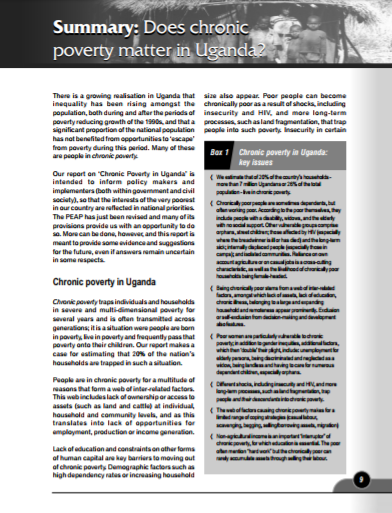
This report on Chronic Poverty in Uganda is intended to inform policy makers and implementers (both within government and civil society), so that the interests of the very poorest in our country are reflected in national priorities.