Harnessing Growth Poles for Poverty Reduction and Climate Resilience in Zambia

Zambia is increasingly exposed to climate-related shocks, particularly droughts and floods, which continue to undermine agricultural productivity, household welfare, and long-term development. In response, geographically concentrated investments – referred to as growth poles – have been promoted as engines of pro-poor growth and resilience. However, evidence of their effectiveness is limited. This study examines whether and how growth poles contribute to poverty reduction and climate resilience using a mixed-methods approach that combines nationally representative spatial data from Living Conditions Monitoring Surveys, panel data on poverty trajectories from the Rural and Agricultural Livelihood Survey, and qualitative evidence from focus group discussions, life histories, and key informant interviews conducted across selected growth pole districts, including including farm blocks, mining areas, national parks, and sugar estates.

The findings show that growth poles can stimulate economic activity and generate new livelihood opportunities, but their impacts are uneven and context-specific. Agro-industrial growth poles, particularly sugar estates, exhibit the strongest poverty outcomes due to deeper integration with local production systems and labour markets. Mining areas generate significant economic dynamism and employment opportunities, but benefits are uneven, often accruing to individuals with higher skills, capital, or social connections, including migrants. In contrast, farm blocks and national parks show persistently high poverty levels, reflecting limited infrastructure, restricted access to productive resources, and the seasonal or unstable nature of available opportunities.

Proximity to growth poles does not automatically translate into improved welfare. Only a small share of households live close to these investments, and poverty remains high even among nearby communities. In some cases, households located in intermediate zones (21–60km from growth poles) exhibit better poverty outcomes than those closest to growth poles, suggesting that spillover benefits – such as improved market access – extend beyond core investment areas while avoiding congestion and rising living costs. Growth poles contribute to livelihood diversification, which is a key pathway to resilience. Households engaged in non-farm employment, enterprise activities, and diversified income portfolios are better able to cope with climatic shocks. However, the resilience benefits of diversification depend on the quality and stability of these opportunities. In many cases, growth pole-linked employment is informal, low paid, and seasonal, limiting its ability to provide sustained protection against shocks.

A central finding is that growth poles generate selective rather than broad-based welfare gains. Households with greater amounts of assets, more education, and more developed social networks are better positioned to benefit from employment, contracts, and supply opportunities. As a result, growth poles contribute to localised economic transformation while reinforcing socioeconomic differentiation. Importantly, households that do not benefit are not necessarily worse off than before, but experience more limited gains relative to others, reflecting uneven inclusion rather than absolute decline. The study also finds that growth poles do not automatically enhance climate resilience. In some contexts, particularly mining aeras and farm blocks, resilience has declined over time due to unstable livelihoods, continued reliance on climate-sensitive agriculture, and structural constraints such as limited land access and weak market integration.

Policy implications emphasise the need for complementary interventions. Strengthening household asset bases is critical for enabling participation in growth pole economies and enhancing resilience. Improving access to appropriately structured finance – particularly for productive investment – can support livelihood upgrading, though grant-based support remains necessary for poorer households. Promoting diversification must be accompanied by efforts to improve the quality and stability of non-farm employment. Strengthening local participation in supply chains is essential to ensure that growth pole demand benefits surrounding communities. Finally, extending investments beyond core growth pole areas can enhance spillover benefits and support more inclusive regional development.

Overall, growth poles have the potential to contribute to poverty reduction and climate resilience, but only when they are supported by policies that expand access to opportunities and address underlying structural inequalities. Without such measures, their benefits are likely to remain localised and uneven.

Authors: Mary Lubungu, Benny Kabwela, Brian Mulenga, Richard Bwalya, Arthur Moonga
Poverty in Polycrisis

We are living in a period of global volatility in which intersecting crises are combining with devastating impacts for people already living in and near poverty. This book carefully examines the dynamics of these crises and challenges us to find new ways forward for policies and programming that more effectively meet the needs of the world’s most vulnerable populations.

The book highlights lived experiences of those who are impacted most by poverty amidst intersecting crises—namely climate-related disasters, violent conflict and economic instability— drawing on the author’s 15 years of experience in sub-Saharan Africa and South and Southeast Asia. It examines chronic poverty amidst intersecting crises, highlighting how new impoverishment may emerge, and even surprisingly how some people manage to escape or remain out of poverty in these contexts. It offers a multi-scalar, dynamic investigation of poverty and intersecting crises to identify ways forward for policies and programming.

It is an essential read for practitioners working on poverty and inequality reduction in low- and middle-income countries, as well as for researchers and students of global development, environmental and peace studies, and economics, public policy, and sociology more broadly.

Written by Vidya Diwakar, IDS Research Fellow and CPAN Deputy Director

National Report - Zambian Poverty Dynamics and Climate Resilience: A Growing Policy Agenda Through a Period of Crises

This report synthesises the key research findings of the Zambia Poverty Dynamics programme since the last national report in 2021, whose key findings and recommendations are summarised in Box 1.1. Many dimensions have remained the same; however, the main changes include: (1) a dramatic reversal in urban poverty reduction; (2) a very significant increase in new policy developments, especially in human development, although not yet in ‘growth from below’, but significant progress was achieved in fisheries with the return of fishing ban periods each year on major rivers and lakes to allow fish stocks to recover, laying the foundation for income growth in fishing.

This report starts by laying out which policy interventions have become significantly more visible and impactful since the last report, presenting the evidence from quantitative and qualitative research, and focusing on governance and implementation issues. Policy interventions are even more critical to poverty reduction and climate resilience in the Zambian context, it is argued, because of the ‘enclave’ nature of the dominant mining sector, which leads economic growth, at least when commodity prices are high (Pijuan Sala and Tudela Pye 2024), and which the current government wishes to grow rapidly. The majority of Zambians are employed or self-employed in comparatively low-productivity sectors, agriculture and services, which are generally disconnected from mining and other formal sectors such as tourism. Resulting high levels of inequality do not generate the market demand for micro- and small businesses’ outputs and services, leaving these with low investment and productivity. But they do generate the need and potential for redistribution through taxation, even if fiscal resources are for the moment heavily constrained by debt servicing.

As a result of these high inequalities, growth has not carried everyone with it. Therefore, only interventions will assist poor and vulnerable people to improve their life chances, until the pattern of growth changes and begins to make a contribution. So far the most successful interventions have been in human development. Their success has been extremely valuable but has not yet laid the foundations for more inclusive growth from below, which is necessary if poverty is to be sustainably reduced. Both of these – human development and growth from below – are required to enable sustained escapes from poverty or ‘graduations’, which are the objective of anti-poverty policy.

The report goes on to briefly assess the effects of the multiple crises that have assailed Zambia in the past five years, with an analysis of impacts on urban populations, and differentiating between extremely poor and moderately poor households, and men- and women-headed households. It also looks at policy responses to these crises, including disaster risk management, and raises the question of how to respond in the likely event that such crisis-prone times continue. This is followed by a closely related discussion on whether and how more widespread resilience to climate change might be achieved. The analysis is gendered throughout, and concludes with key policy and programming recommendations.


Authored by Andrew Shepherd, Richard Bwalya, Antony Chapoto, Lucia da Corta, Marta Eichsteller, Vidya Diwakar, Marja Hinfelaar, Mary Lubungu, Arthur Moonga, Brian Mulenga, Kate Pruce, Joseph Simbaya

Click here to read the full National Report

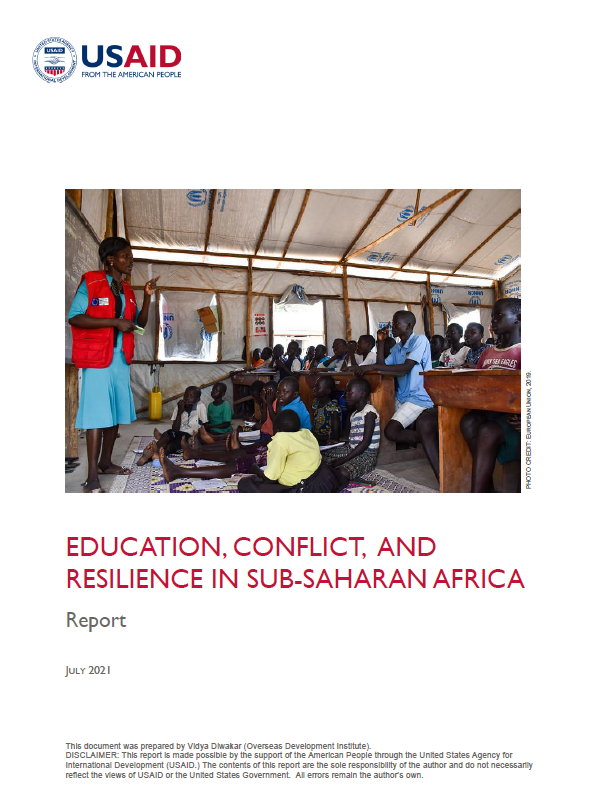
Education, conflict, and resilience in Sub-Saharan Africa: Report

The Sustainable Development Goals call for action in many areas relevant for girls and boys, not least quality education, but challenges in achieving progress may be aggravated by factors including poverty and armed conflict. Conflict has negative impacts on education, which can operate through a variety of supply- and demand-side channels. It can destroy infrastructure, displace students and teachers, and modify the returns to schooling, all of which can limit school enrolment (e.g. Akresh and de Walque 2008; Dabalen and Paul 2014; Serneels and Verporten 2012; Poirier 2012; Bertoni et al. 2019). Even in countries where primary school enrolment rates may be increasing, conflict can widen disparities in education access and contribute to the intergenerational transmission of poverty.

In this context, strengthening resilience capacities that can enable children living in conflict-affected areas to continue to access education is critical. USAID’s 2018 Education Policy recognizes that in order to strengthen resilience, “education in partner countries must have the capacity to embed effective approaches to improving learning and education outcomes, to innovate, and to withstand shocks and stresses” (USAID 2018, p. 17). Conflict is generally not a “shock” but more a social process, reflecting something structural and with a long time-dimension (though a single conflict event and its impact may be experienced as a shock locally). The ability to access education in contexts of protracted crises is critical.

This report examines the links between conflict, education, resilience and poverty dynamics in sub-Saharan Africa in a set of USAID Resilience Focus Countries. It relies on panel data from Ethiopia, Malawi, Niger, Nigeria, Uganda, and the Democratic Republic of Congo (DRC) to investigate the relationship between conflict and education, focusing on girls and boys in households on different poverty trajectories (see Box 1). It then builds on Diwakar et al. (2021) to examine the types of resilience capacities that can promote school access for children in conflict-affected areas. In doing so, the paper attempts to contribute to the knowledge base on the pathways through which conflict affects education differently for girls and boys in households on different poverty trajectories, and how resilience capacities of households and institutions can be supported to contribute to increased enrolment in situations of conflict and violence.

Author: Vidya Diwakar

The full report can be downloaded here

The associated brief can be downloaded here

Poverty and wellbeing before and during Covid-19 in Cambodia: an assessment of trends and correlates

This study investigates factors affecting welfare prior to and during Covid-19. It employs analysis of the Cambodia Living Standards Measurement—Plus Survey 2019/20 data, alongside five rounds of the Covid-19 High Frequency Phone Surveys between May 2020 and March 2021 to assess socioeconomic impacts of the pandemic.


The results point to a range of factors which could contribute to explaining poverty incidence prior to the pandemic. Household resource endowment was an important correlate of welfare, particularly in terms of possession of a mobile phone, ownership of livestock and land and access to electricity. Other factors include access to financial services, education, involvement in non-agriculture businesses, migration and remittances. However, a range of these variables are being constrained during Covid-19. For example, analysis of Covid-19 phone surveys points to the severity of income loss both in terms of breadth (share of households affected) and depth, the latter more pronounced in proportional terms among households in the bottom two quintiles with an already low consumption base, and also severe among IDPoor households. In other words, not only has income loss been deep, but it continues to get deeper over time, starting from a low base. This suggests that there are considerable processes of impoverishment (breadth), but also destitution (depth) in Cambodia as a result of Covid-19.


As a result of shocks, households were forced to rely on a range of coping strategies, especially reducing consumption, taking loans and, for poorer households in later survey waves, accessing social protection. Reliance on support from friends has been reducing over time, perhaps a result of community networks thinning out. Even though the roll-out of cash transfers has eventually reached many ID Poor households, levels may not be adequate resulting in reductions in food consumption among poorer households and continued food insecurity.


The results point to areas for policy and programming focus, including helping to narrow development gaps by area of residence alongside a regional levelling up focused on the Tonle Sap region. Alternatives to borrowing as a coping strategy are also worth considering, alongside improvements in inclusive access and quality of financial services to help mitigate the adverse consequences of indebtedness. Alongside this is a need to focus attention on children who have missed out on school and learning, particularly from poorer households.

Authors: Vidya Diwakar and Vathana Roth, with Tony Kamninga

Paper can be downloaded here

Welfare of Young Adults amid COVID-19, Conflict, and Disasters: Evidence from Afghanistan

Afghanistan has experienced decades of conflict-related insecurity and disasters, a situation that has been exacerbated by the onset of the novel coronavirus disease (COVID-19). This paper employs the Income, Expenditure, and Labour Force Survey (IE&LFS) 2019-20 to quantitatively analyse poverty and welfare loss in Afghanistan. This analysis hence covers the period before August 2021, offering an important baseline to examine deteriorating situations in subsequent years. It finds that rates of poverty and welfare loss increased during the onset of the pandemic, especially among poor households, potentially reflecting new impoverishment as well as destitution processes. Though these rates were comparable across age groups, in absolute terms, they represent approximately 4.7 million young adults living in poverty in 2019-20. Youth-headed households were disadvantaged in terms of a lower asset base. Though they had more years of schooling, and higher rates of salaried employment and migration that both helped protect against poverty, during COVID-19 they were more likely to record a temporary layoff, reflecting the precariousness of youth employment.


Disasters, insecurity, and a range of negative shocks and stressors alongside COVID-19 contributed to welfare loss, and, in some situations, were amplified during the pandemic. Many households reduced expenditures and the quality or quantity of food in response to these shocks, particularly during COVID-19. Food insecurity was a related consequence, heightened during the pandemic, especially among youth-headed households. Other responses common during COVID-19 included an increase in work-related strategies, potentially substituting a decline in social capital within the community. Though the rate of economic activities among women in general was strikingly low, there was a slight increase in employment during COVID-19 among women in poor households, and among women in households experiencing disasters or in insecure areas amid COVID-19. This may point to a potential narrowing of the gender differential in employment in crisis contexts, though this itself is a sign of distress where women in poverty may have no recourse but to engage in precarious work and uphold an increased work burden to meet household needs in times of distress.

Author: Vidya Diwakar

Paper can be downloaded here

The Political Economy of Sustained Escapes from Poverty in Ethiopia, Rwanda and Tanzania

This paper examines the politics of poverty reduction in Ethiopia, Tanzania and Rwanda using the political settlements framework. It discusses the extent to which the political settlement prevailing in any country influences the consistency and quality of policy making and the success or failure of anti-poverty policies and initiatives

Read More

RESILIENCE AND SUSTAINABLE POVERTY ESCAPES IN RURAL KENYA - Country Report

The report investigates the resources (land, livestock, and assets), attributes (household composition and education level), and activities (including jobs and engagement in non-farm activities) of households that enable them to escape poverty sustainably and minimise the likelihood of returning to living in poverty again

Read More